Thursday, March 15, 2007

You Can't Make This Up, Dept.

From the Washington Post:
Tsuriel Raphael, Israel's ambassador to El Salvador, was yanked after local police found him in the embassy yard "naked, bound and drunk." According to reports, a number of sexual toys and devices surrounded the "longtime" envoy who informed police of his identity after they removed a ball-gag from his mouth.
Update: More from the UK Guardian, which says the incident raises issues of "transparency in recruitment and promotion procedures" for the Israeli foreign ministry:

As an Israeli ambassador, Tsuriel Raphael was accomplished at putting a gloss on delicate subjects, be it Tel Aviv's nuclear programme, the treatment of Palestinians or the invasion of Lebanon. When San Salvador police discovered him in his official embassy residence yard in the capital San Salvador, however, smooth talk was not really an option. For starters there was the gag and the rubber ball in his mouth. There was also the matter of being drunk. And naked. And bound. And surrounded by sex toys. Once he was untied and the gag and ball were removed Mr Raphael identified himself as the ambassador but for perhaps the first time in his diplomatic career, this was a crisis he could not explain away.

The ambassador did not break any law so for the Salvadorean police the case is closed.

What went wrong in Iraq

What about our strategy in Iraq was problematic? Matthew Parris has the answer:

The strategy failed because of one big, bad idea at its very root. [Namely, the neocons'] idea that we kick the door in. Everything has flowed from that.

We were not invited. We had no mandate. There were no "good" Iraqis to hand over to. We had nothing to latch on to, no legitimacy. It wasn't a question of being tactful, respectful, munificent, or handing sweets to children. We were impostors, and that is all.

Read the whole thing, which goes on to eviscerate all the excuses the neocons now make.

Some wars you're just going to lose, regardless of the brilliance of your strategy. Postcolonial wars of occupation, without an exception I can think of, all fall into that category.

Monday, March 12, 2007

The right way to think about climate impacts

My last post mentioned the problems with The Atlantic's approach to climate change, which started from a set of (simplified) predictions about the future of the weather, and thus reached startlingly wrong-headed conclusions about the likely winners and losers from those changes. By contrast, the current issue of the Bulletin of the World Health Organization offers a much more useful approach, rooted in this case in an examination of climate-vulnerable public health systems, and then trying to reason as to how those systems might react (or fail to do so) to the challenge of climate change. Note in particular the way that the interaction effects between different vital systems are linked together (highlighted):

Some essential principles are already clear. A global problem requires a strategy of international dimensions that can translate into regional and local actions. Just as climate change's underlying causes are global, its health implications do not respect national boundaries. Impacts in one location, such as infectious disease epidemics or population displacements caused by droughts or rising sea levels, quickly spread across national borders. Coordinated investments in preventive measures therefore contribute to the "global public good" of reducing the risk of health emergencies. The challenge is simplified somewhat by the fact that climate change is expected to lead mainly to changes in existing health issues rather than to the emergence of new and unfamiliar diseases....

One emerging environmental health threat is the decline in global freshwater resources, caused mainly by increasing rates of water extraction and contamination. Climate change is expected to worsen this decline in water quality and quantity, particularly in already dry regions such as the eastern Mediterranean and north Africa. Scaling up water and sanitation services and providing point-of-use disinfection would reduce the current burden of disease and ameliorate the health impacts of decreasing water supplies. Such interventions already have a very high cost–benefit ratio; the threat of climate change makes these preventive health measures an even wiser investment. As water stresses intensify, governments could protect health by strengthening and enforcing their regulatory frameworks to ensure the safe use of new water sources that will become increasingly important: wastewater, excreta and greywater in agriculture and aquaculture....

Many climatic risks to health lie at least partly outside the health sector’s normal sphere of action. Perhaps most critically, climate change has the capacity to suppress agricultural yields, with the greatest risks in Africa, where malnutrition is already the largest single contributor to disease burdens. Some of the most effective actions by health professionals may therefore involve supporting other sectors’ efforts to mitigate and adapt to climate change.

It's all about the vital systems, all of which are interconnected in a series of overdetermined feedback loops.

Friday, March 09, 2007

The wrong way to think about climate change impact

An excellent example of the wrong way to think about the future of climate change appears on the cover of this month's Atlantic. Gregg Easterbrook addresses the important topic of who will be the winners and losers in climate change. But his approach to answering that question goes dramatically astray because of a basic methodological flaw: he starts his impact analysis by looking at the change to the weather (which he reduces to "warmer everywhere," ignoring regional variations and the perhaps even more important hydrological shifts that climate change will produce), thereby ignoring the crucial question of which places are in the best position to adapt to the changes in the weather. He simply assumes that all places are equally well positioned to respond to increases in temperature, concluding that places that are already really hot are going to be in trouble, whereas places that are currently cold are going to be better off.

The point is clearest in his discussion of how climate change may impact the price of Russian real estate:

Russia! For generations poets have bemoaned this realm as cursed by enormous, foreboding, harsh Siberia. What if the region in question were instead enormous, temperate, inviting Siberia? Climate change could place Russia in possession of the largest new region of pristine, exploitable land since the sailing ships of Europe first spied the shores of what would be called North America. The snows of Siberia cover soils that have never been depleted by controlled agriculture. What’s more, beneath Siberia’s snow may lie geologic formations that hold vast deposits of fossil fuels, as well as mineral resources. When considering ratification of the Kyoto Protocol to regulate greenhouse gases, the Moscow government dragged its feet, though the treaty was worded to offer the Russians extensive favors. Why might this have happened? Perhaps because Russia might be much better off in a warming world: Warming’s benefits to Russia could exceed those to all other nations combined.

This is a classic statement of linear reasoning about the impact of climate change: Russia's problem is that it's too cold; ergo, in a hotter world, Russia becomes a nicer place. It's also a dramatically wrong conclusion.

The main determinant of the price of real estate is whether the property is located in a place that is nice to live, to vacation, to extract resources, or to farm. A huge determining factor for that "niceness" is whether the place has effective and reliable vital systems -- e.g., energy generation and distribution; telecommunications; water supply; food production and distribution; public health; transportation systems (fuel supply, railway network, airports); and security services (police, military). All of these vital systems are liable to be put under severe stress by climate change. To determine which places are likely to win or lose as the climate changes, you need to start by figuring out the places that have the most resilient vital systems.

Although Russian elites may find it convenient, given their grand strategy of wielding influence by controlling global hydrocarbon supply, to tell themselves that a warmer Russia is a better Russia, the sad truth is that climate change is likely to be disastrous for the country, given the awful state of many of its vital systems. Food production and distribution is tenuous, public security is awful, and the health care system has already cratered. Do you really think a place like that is likely to be the site of a great property boom? Is a Siberian steppe which is again a malarial swamp going to be a good place to buy real estate? Is a place where the rich can't walk down the street without a bodyguard really going to replace St.Tropez as a destination of choice? Is a place where the aquifers have been destroyed likely to be the world's next great breadbasket?

Thursday, March 08, 2007

British may bring climate change to Security Council

A spot of good news that people are waking up to the real seriousness of the climate change problem:

The British government is considering putting climate change on to the agenda of the UN security council for the first time to underline the urgency of the issue.... Global warming has thus far been considered outside the remit of the council, which is mandated under the UN charter to maintain "international peace and security".

The British government - led by key figures including Tony Blair, Gordon Brown and David Miliband - has come to the view that it is a matter of international security as it will cause mass migrations and aggravate disputes over borders, water and other resources.

The foreign secretary, Margaret Beckett, raised what she called climate security in her speech to the UN general assembly in September. "Our climate presents us with an ever-growing threat to international security. Dealing with climate change is no longer a choice, it is an imperative," she said.

A report commissioned by the US government warned at the weekend that the US must prepare to intervene in a growing number of major crises across the world brought on by climate change, such as water shortages, collapses in civil order and "the implosion of one or more major cities".

Unrestrained greenhouse gas emissions and the expected temperature rise over the coming decades could provoke social unrest in vulnerable places from Delhi and Mexico City to Lima, said the report by Global Business Network (GBN), a consultancy group in San Francisco.

It said action may be needed soon to "forestall the worst effects of collapsing ecosystems, water systems, or radical restructuring of the global insurance industry" and warned that US policies on global warming could threaten its strategic interests abroad and weaken its bargaining power on key issues such as trade and security.

Friday, March 02, 2007

Systems vulnerability

The central argument of the climate change paper we released today is that the right place to start an analysis of where climate change is going to hit hardest is by looking not at the places where climate will change most or fastest, but rather by looking at the places where vital systems are already stressed. These are the places where even a small amount climate change can potentially precipitate a collapse of the economy, the public health system, civil order, or all of the above. By contrast, places with resilient vital systems are likely to be able to accommodate mild change and even quite drastic change.

Consider the contrast between the Netherlands and Bangladesh. Here are two countries that, on the face of the climate evidence alone, would seem equally vulnerable to climate change: both are densely populated countries, at or below sea level, and at risk of violent storms. Yet Bangladesh is far more vulnerable to climate change, and the results of climate change, as they unfold, are likely to be much more dramatic there than in the Netherlands. How do we know that? We know not because the climate science has improved dramatically in its ability to forecast regional impacts of climate change in South Asia versus Northwest Europe. Rather, we know this because we know that the Netherlands's various vital systems -- communications infrastructure, public health system, water delivery system, food supply system, transportation infrastructure, public security, and so on -- are in much better shape than Bangladesh's. Although an acute, climate-change-driven weather event may impact any one of those systems in either country (and you can't predict exactly when or how that will happen), Bangladesh with its many stressed vital systems, is far more likely than the Netherlands to experience not only the failure of a single vital system, but also a cascading series of failures across vital systems. And we know this not by looking at the climate science, but by looking at the social science.

When Peter says that 60 to 100 million people may be displaced in the Bangladesh, he's not kidding. Check out this image from the LA Times:And the line on that map represents merely the place where the new permanent shoreline will be. Keep in mind that the water level will be far further inland during a big storm surge. When some Katrina-style typhoon roars in from the Bay of Bengal, the amount of land under water will be vastly greater. This is why Peter's estimation is not only not exaggerated, it's almost inevitably going to happen.

The next step is to imagine what a displacement of 60m people looks like. What kind of a humanitarian mission gets mounted? Where do the refugees go? Do the Indians let them in? Do they stay? How does the worldwide Muslim community react to the crisis? This is why a publication as sober as The Economist labels climate change one of the three greatest security challenges of the 21st century, alongside terrorism and failed states.

Thursday, March 01, 2007

Climate Change

I try to avoid self-promotion on this site (inasmuch as blogging ever avoids such). But I am nonetheless proud to announce that the results of a project I led last fall on how to think more clearly about the impact of climate change are finally seeing the light of day, and in the Washington Post, no less:

The scientific debate about whether there is a global warming problem is pretty much over. A leading international group of climate scientists reported last month that the evidence for global warming is "unequivocal" and that the likelihood it is caused by humans is more than 90 percent. Skeptical researchers will continue to question the data, but this isn't a "call both sides for comment" issue anymore. For mainstream science, it's settled.

The question now is what to do about global warming. This is a political problem more than a scientific one. The solutions (if we can agree on any) will require political will and imagination -- and also pain. That was my only reservation about the Oscar night celebration of Al Gore's leadership on this issue. The gowns and black ties and the celebrity back-slapping made it look like dealing with global warming will be fun, a walk down the red carpet. But it's more likely to be about catastrophe and how to share the pain.

These issues come into focus in a startling new report by futurist Peter Schwartz. He turns the usual discussions upside down: Rather than starting with detailed estimates of climate change (how much temperatures will increase; how much sea levels will rise; what new diseases will be spawned), he looks instead at systems that already are vulnerable to such stresses.

What Schwartz discovers with his stress-testing makes climate change even scarier: The world already is precarious; the networks that maintain political and social order already are fragile, especially in urban areas; the dividing line between civilized life and anarchy is frighteningly easy to breach, as the daily news from Iraq reminds us. We look at the behaviors of butterflies and migratory birds as harbingers of climate change. But what about early effects on human beings? "The steady escalation of climate pressure will stretch the resiliency of natural and human systems," writes Schwartz. "In short, climate change pushes systems everywhere toward their tipping point."

Schwartz's report, "Impacts of Climate Change," was prepared by his consulting group, Global Business Network, for a U.S. government intelligence agency he doesn't identify. The text of the report is available at the online discussion forum PostGlobal ( http://www.washingtonpost.com/postglobal). Here's a brief trek through the ravaged landscape Schwartz describes.

A first set of disasters waiting to happen involves stressed ecosystems. Human actions -- deforestation, overfarming, rapid urbanization -- have created special vulnerabilities to catastrophic natural events that are likely as the climate changes globally. In an interview, Schwartz cited the example of Haiti, which because of deforestation and loss of topsoil is "an ecosystem at the edge." A prolonged drought or a devastating hurricane could tip Haiti over that threshold -- and produce a refugee crisis of tens of thousands of boat people fleeing a devastated country.

Or take the problem of rising sea levels: Climate scientists are uncertain how fast the icecaps will melt and the seas will rise. But in Bangladesh, where millions of people live at or near sea level, even a small increase could produce a catastrophe. In a severe monsoon, 60 million to 100 million people could be forced to flee inundated areas, Schwartz warns, producing "the single greatest humanitarian crisis we have ever seen."

Lack of water may be as big a problem as flooding. Schwartz notes that more than 700 million people now live in arid or semi-arid areas. Climate change could tip this balance, too, producing severe water shortages and even "water wars." Tens of millions of people may become water migrants. The world's feeble political systems can't cope with existing migration patterns, let alone this human tide.

And finally, there is the problem of maintaining social order in a stressed world. You don't have to go to Baghdad to see how quickly the social fabric can be shredded; just look at New Orleans after Hurricane Katrina. The stresses come in part from rapid urbanization. Schwartz notes that in 1900, one in 20 people lived in cities; today it's about half, and the percentage is rising fast. Without strong and supple governments, this could become a world of vigilantes and militias, desperate to control scarce resources.

The big problems in life aren't the ones that hit you by surprise but the ones you can see coming. That's surely the case with climate change: We can measure it, we can imagine its catastrophic effects. But can we do anything to stop it? If we let ourselves visualize how bad it could get, as Schwartz does in this report, will we make changes that might reduce the disaster? That's the real stress test: It's coming at us. What are we doing about it?

Thank you Peter, Stewart, Doug, Derek, Rebecca, Nancy, and above all, the many brilliant people we interviewed on this project.

Wednesday, February 21, 2007

Voting on "Armenian Genocide"

I just got back from spending a few days in the Near East, interviewing various worthies on the state of play in their countries, and in particular on how they view the United States. I was struck in particular by the situation in Turkey, where literally every single person I talked to, from cab drivers to CEOs of huge companies, mentioned the issue of the forthcoming vote on whether the U.S. should declare the slaughter of Armenians in the late phases of World War I to be an official "genocide." The reaction from the Turks to this forthcoming vote, which has barely hit the radar screen of anyone in the U.S. outside the Armenian-American community and those whom they lobby, was unadulterated horror. Congressmen preparing to vote on whether the United States shall officially declare the World War I-era Turkish massacres of Armenians a genocide should consider how such a -- let's face it -- purely symbolic vote is likely to impact real American interests in the Middle East.

Should Congress make such a declaration, the consequences for American interests in Turkey and the surrounding neighborhood (including Iraq and Iran) could be momentous. Turkey is a longtime ally of the United States, a member of NATO since 1952 (with NATO's second biggest Army), and a stalwart participant in the global war on terror. It is also a bellwether in the underlying cultural struggle that defines that war. A historically pro-Western Muslim country, Turkey straddles many of the world’s critical geopolitical and cultural fault lines: it is both European and Middle Eastern, both multicultural and fiercely nationalist, both liberal and ruled by moderate Islamists (the AKP). Each of these tensions within Turkish society is fiercely contested, however. There are stark debates about whether Turkey should orient toward secularism, liberalism and the West, or instead look East, including perhaps to Iran. How the United States (and the European Union) treat Turkey has a material impact on this question. Insofar as Turkey sees itself as being rejected or insulted by the West, the more likely it is to turn away from the West, something Joschka Fischer has perceptively stressed.

My research in Turkey entailed meeting with people from a diverse swath of Turkish society, to better understand the underlying dynamics of change in Turkey and its neighborhood, including the European Union to the West; Iraq, Syria, and Israel to the south, and the Caucasus and Iran to the East. I met people from across the political spectrum, including Kemalist-nationalists, liberals living with official protection because of personal threats from Islamists, pro-democratization activists, Turkish professors of political science, and others.

My purpose in visiting to Turkey was to explore how the United States is viewed in Turkey. With stunning consistency, the first response by Turks to this line of inquiry was to refer to the upcoming vote in the Congress on the Armenian matter. Regardless of their political stance, the Turks I spoke with universally regarded it as horrific that the United States should so much as consider a bill regarding the Armenian genocide. To be sure, it was unsurprising to hear Kemalists, who have always denied the notion of an Armenian genocide, denounce the bill. What was remarkable, however, was to hear anti-Kemalists, many of whom themselves recognize the 1915 massacres as a "genocide," worry that the passage of such a bill would only create a nationalist backlash within Turkey, strengthening the hands both of those who seek to deny the genocide, and of those who seek to turn away from the West.

Many Americans, and many in Congress, feel an understandable desire to stand in solidarity with the historical injustices perpetrated on Armenians. In contemplating the Armenian genocide bill, however, Congressmen should recognize that a vote in favor of declaring these injustices a "genocide" would be almost universally interpreted within Turkey as an unprovoked, unnecessary, and unpardonable affront to Turkey’s national honor. As one leading Turkish businessman, a thoroughly Westernized liberal, put it, "Imagine how the United States would react if China passed a bill demanding that the United States make reparations to African-Americans." Another informant, a professor of management at the American University, suggested that were the Armenian genocide bill to pass, it might no longer be safe for Americans to travel within Turkey. (The murder last month of the Armenian-Turkish journalist Hrant Dink by a nationalist fanatic suggests that such worries are not idle.) A sizable majority of those I spoke with believe that should the genocide bill pass, everything about the United States-Turkish strategic relationship would be up for renegotiation, including U.S. basing rights in Turkey and Turkey's active cooperation with the United States in counterterrorism. It is worth asking what the United States gains by knowingly provoking such potential reactions.

To understand why many Turks might react so violently to the passage of this bill, one must appreciate the anxieties many Turks have about the territorial integrity of their country. Not only did Turkey lose nearly two thirds of its territory after World War I, it was also left with large, regionally-based ethnic minorities, several of which today continued to harbor armed separatist movements. Some in Turkey consider the United States to be conspiring with these forces, either out of inattention, or (some mutter) because of an active desire to weaken the Turkish state. For example, for more than a decade and at the cost of tens of thousands of lives, Turkey has been fighting its own "war on terror" against the Kurdish People's Party (PKK), an organization the U.S. State Department designates as a terrorist organization. A major military challenge for Turkey is that the PKK uses northern Iraq as a staging area for its insurgency in southeastern Turkey, something the United States has largely turned a blind eye to, for fear of alienating our only friends Iraq, the Kurds. In Turkey’s eyes, however, American passivity in the face of Turkey's #1 terrorist threat betrays the rhetoric of a "global war on terror." Should the PKK become more aggressive, or if an independent Kurdistan emerges in Northern Iraq, a Turkey outside American influence might not hesitate to intervene militarily in Iraq, both to quash the PKK and perhaps to renew its historical claims on Mosul.

I don't have a position on whether the tragedies and atrocities of 1915 amount to "genocide" -- a matter best decided by historians than by politicians in foreign countries. But even assuming it was a genocide, the United States should still ask what it has to gain by passing a resolution declaring it so. This gain should then be weighed against whatever harm such a vote might do to American national interests in Turkey and the Middle East. Insofar as American national interests involve having Turkey on our side in the war on terror, oriented toward the West, and committed to a moderate form of Islam, should the United States take the risk of alienating this key regional ally just to make a symbolic point about horrors that took place nearly a century ago?

Sunday, January 28, 2007

Claudio Guillen

My great uncle Claudio Guillén died yesterday evening. Claudie, as the family called him, was an intellectual in the best European tradition: man of bottomless learning and infinite curiousity, yet at the same time fundamentally humble and always open to new experiences. He was also a great academic innovator: one the earliest practitioners of the discipline of comparative literature, he spent much of his career setting up departments of comparative literature at universities across the world: from Princeton to San Diego to Buenos Aires to Barcelona. Despite being the son of one of the most famous literateurs in all of Spain, he moved out of his father's shadow and became recognized as a great mind in his own right.

Here's the obituary in El Pais:
Un sabio de la crítica literaria
El maestro de la literatura comparada

Claudio Guillén, académico y crítico ejemplar, falleció ayer en Madrid a los 82 años

Claudio Guillén, académico, profesor, era el amigo de todo el mundo: en la Real Academia, en la Universidad, en su generación, en las que vinieron. Su muerte, ocurrida repentinamente a medianoche del sábado en Madrid, mientras veía la película La Reina de África en La 2, llenó de consternación y de pena a los muchos que le conocieron. Tenía 82 años, y mantenía el porte juvenil que Domingo Yndurain, académico también fallecido, calificaba como de "noble elegantemente desmadejado".

Fue soldado en la II Guerra Mundial y luchó por la República en España

Era un maestro de la literatura comparada; la introdujo en España, la enseñó en Harvard y en otras universidades del mundo. Fue soldado en la II Guerra Mundial con De Gaulle, y también luchó a favor de la República en la guerra civil española. Era hijo de Jorge Guillén, el gran poeta de la generación del 27. Pero nunca presumió de nada; estuvo en mil batallas, pero nunca contó batallitas.

Su compañero Ángel González estuvo el jueves con él en la Academia. Claudio se le acercó, charlaron, y en algún momento evocaron a don Jorge; Claudio se llevó a un lado al poeta y le dijo al oído: "Escucha esto de mi padre; a ti sí te lo puedo decir...". Estaba hecho de la elegancia de los que no son presuntuosos.

Natacha Seseña, historiadora del arte, amiga suya desde 1955, decía ayer tarde: "Era muy guapo, de una sensibilidad extraordinaria. Amaba España, pero quizá una España que no existía. El que mejor estudió la literatura española. Iba al fondo de las comparaciones". Beatriz de Moura, directora de Tusquets, su editora, lo recordaba como "un hombre humilde, muy humilde; acaso esa humildad contribuyó a que en España fuera menos reconocido que en el resto del mundo". El director del Cervantes, César Antonio Molina, abundó: "Era una autoridad. Un día me dijo George Steiner que era el único especialista en literatura comparada que merecía la consideración de un maestro, similar a la del propio Steiner".

Claudio Guillén nació en París en 1924; su madre era francesa, y en Francia vive ahora su hermana Teresa. Claudio y su esposa habían estado trabajando, hasta las ocho de la noche del sábado, en el epistolario de don Jorge y en el prólogo que formará parte de la edición especial de Cien años de soledad, de Gabriel García Márquez, que prepara la Academia para rendir homenaje a Gabo cuando se celebren en Colombia el Congreso de la Lengua, los 80 años de hijo del telegrafista de Aracataca y los 40 de la aparición de su texto más célebre.

Claudio Guillén dio por concluido su exilio en 1982; obras suyas fueron Entre lo uno y lo diverso y Múltiples miradas; ingresó en la Academia en febrero de 2003.

Víctor García de la Concha, el director de la Academia, estaba consternado. Él recibió la primera noticia, y ayer, cuando habló, manejaba ese texto introductorio de Cien años de soledad. Lo habían estado comentando el jueves último Francisco Rico y él con el propio Claudio, poco antes de que la institución le dedicara un homenaje a Francisco Ayala.

Estaba lleno de vida, y de proyectos, decía el director de la Academia; el epistolario de don Jorge le llenaba de ilusión. Quería trabajar con José Manuel Caballero Bonald en las cartas que se intercambiaron éste y su padre; Caballero (que el año pasado entregó a Guillén el premio de su fundación por la obra Entre lo uno y lo diverso) se mostraba "anonadado"; era, dijo, "un gran crítico, un hombre que luchó siempre por superar los nacionalismos culturales, y consiguió en este terreno logros magníficos. Heredó de su padre esa pinta magnífica, la caballerosidad, los buenos modales". Francisco Ayala, en cuyo homenaje académico cumplió Guillén su último acto público, tenía la misma impresión cuando ayer supo que su compañero había muerto. "Era un hombre de gran erudición en cuyo talante personal podía el afán de la amistad. Un amigo".

Víctor García de la Concha aseguró: "No sólo es el introductor de la literatura comparada en España: la introdujo en el mundo; empezó en 1958, cuando era profesor en Harvard; su obra es casi un autorretrato, cosmopolita, universal; estaba equipado para las categorías, no para las anécdotas; era un hombre esencial, respetuoso con lo importante; un gran filólogo viajero, estudió todas las literaturas modernas; vivió el privilegio de ser hijo de la generación que supuso para España un renacimiento literario; es muy europeo, y muy americano; enseñó por todo el mundo; su concepto de la literatura partía del contraste de los arraigos y los estímulos universales". Y eso era lo que estudió, precisamente, en su último trabajo, sobre "el lenguaje de las cosas" en Cien años de soledad.

Su entierro parte hoy del tanatorio de la M-30, a la una de la tarde, hacia el Cementerio Civil de Madrid.
I'll have more personal reflections later.

Thursday, January 25, 2007

The partisan point on the war

1. The Republicans started the war. It was their idea, and their choice.
2. The Republicans lost the war. Either it was never winnable, or they bungled it -- but either way, they lost the war.
3. Now, the Republicans are too prideful to admit they have lost he war. They continue and so want to throw good money after bad on their failed political investment, while at the same time desperately looking for ways to pass the bad political debts to others. Sorry, but no: you get to pay.

Wednesday, January 24, 2007

Rent-a-Demonstrator!

Nice business model:

A German Web site has come up a novel niche market -- renting out demonstrators for public protests. Good-looking protestors can help an organization get its political message to the public for as little as €145 a day....

Judging by their profiles, most of the 300-plus people currently listed in the "rent a demonstrator" category are young and attractive. Potential agitators looking for support for their public protests can choose, for example, Steffen, age 22, 190 cm tall (6 feet 2 inches), "athletic" and with a shoe size of 45. He's available for gigs all over Germany, but says he prefers the state of North Rhine-Westphalia. Or Manuela, who has green eyes and "very long" hair and is available within a 100-kilometer range of Berlin. Included in the extensive personal information -- which at times seems more suited to a dating site -- are skin color and "appearance type," which can be for example "European," "African," "South American" or "Asian."

Best of all, you can book them online.

Friday, January 19, 2007

A Marriage Proposed in Hell?

Concerning the recent revelation that the French prime minister in 1956 proposed subsuming France within Great Britain, the Independent wonders how it might have turned out if they plan had gone forward:

Could such a marriage, between mutually jealous and perennially quarrelling siblings, ever have worked? Fifty years on, we might have blended the best of France and the best of Britain. On the other hand, we might have shared our faults. France might have had our public transport and health systems. We might have had the ramshackle, French university system. We might have had French rates of unemployment. They might have had the London Tube, instead of the Metro.

We both might have ended up with French TV, British hospital waiting lists, the French police, British estate agents, French trades unions, British school dinners, French plumbers and Scottish joie de vivre.

This is of course a gloss on the old joke about "European Heaven and European Hell," which usually goes something like this: in European Heaven, the Italians are the lovers, the French are the cooks, the the Swiss are the bankers, the Germans are the intellectuals, and the English are the police; in European Hell, on the other hand, the Swiss are the lovers, the English are the cooks, the Italians are the bankers, the French are the intellectuals, and the Germans are the police.

Monday, January 15, 2007

"Don't be scared," one of them said. "Feel free."

Sebastian Junger provides an amazing view of Nigeria, and his own pluck:
Mike and I stepped out onto land and were immediately blessed by a man who dipped a handful of leaves into what might have been palm wine and splashed us twice. No one blesses someone before killing him, I thought.
Read the whole thing....

Friday, January 12, 2007

Dirty Kuffar

It's YouTube day here at Small Precautions.

Here's an amazing video example of dark globalization -- a rap video (an originally American artistic genre itself with deep roots in African-American musical forms and the social experience of oppression and resistance) that celebrates jihadi resistance to the U.S.

Footage from Barajas

Surveillance cameras at Madrid's Barajas airport in the very moment that the ETA car bomb explodes (bomb goes off at 0:15).

Apparently the people in the walkway above somehow survived.

Thursday, January 11, 2007

The "hail mary" metaphor

The blogosphere is awash with descriptions of Bush's decision to escalate in Iraq as a "hail mary."

The "hail mary" metaphor is actually too kind to Bush. Hail mary passes make a morbid kind of sense when you are down to the last few seconds of a game and have to score a touchdown to win, in a binary win-lose situation. That metaphor may be fairly accurate as a description of Bush's personal political fortunes and place in history, but it is far from the truth about the grand strategic situation for the U.S.

For the United States--as opposed to for Bush personally--the global situation is bad, but not (yet) nearly so dire. The situation in Iraq undoubtedly poses an existential threat to Bush's legacy, but not (yet) does it pose an existential threat to the United States. Come what may, the country will lumber on after January '09, and a realistic assessment of the country's options at this point do not point to a binary win/lose situation, but rather to a nuanced lose/lose-worse situation. However, instead of focusing on our country's long-term real interests, Bush and team are throwing a hail mary for his legacy.

In other words, the better football metaphor is that Bush is like a quarterback who has thrown three interceptions in the first half of the game; but even as the coach responds to the quarterback's incompetence by calling running plays, the quarterback goes to the line and unilaterally overrides the coach by calling an audible for a hail mary pass, hoping for a miracle that can salvage his reputation. If this were a football game, the coach would certainly bench the quarterback at this point; alas, in our game of political football, we have little realistic possibility for such.

Confidence, Requiescat In Pace

My old high school pal and sometime neocon fellow-traveller, tells it like it is about Bush's plan for limp-wristed escalation in Iraq:
This is really either (more likely) a bunch of hot air (additional carrier strike group, destroying "networks", etc), masquerading as resolve (as Teheran and Damascus will likely smell out), or the beginning of a colossal blunder of epic proportions well beyond the very significant fiasco and disaster we've already witnessed in Iraq. With this team one can't really ever know, of course, a fearful reality indeed as we run out the clock until January '09.

Wednesday, January 10, 2007

Political valences

Via Andrew Sullivan, here's a political questionnaire that puts you on a matrix of left to right and (social) libertarian to authoritarian. I scored as a moderate left-libertarian, and more libertarian (14/20) than left (13.13/20) -- a slightly more pro-business version of Gandhi (ha!).

Tuesday, January 09, 2007

Orwell lives!

Nationalist Socialism

How and why the Bush regime still refuses to come clean with the American public about the real costs of the disaster in Iraq, even as they demand escalation:

For some who continue to support the war, a substantial increase in the tax burden might diminish their support. In fact, taxes have not byeen raised at all since the war began and the cost of the war has been heavily deferred to future taxpayers. Thus, the Bush administration’s tax policy insulates consumers from a truer sense of the cost of the war they are buying.

We can think of this tax policy as a form of artificial government price control that deprives consumers of the price information needed to decide how much to consume of a product. In this case, the product is war. Artificial price (tax) control makes the war seem relatively cheap to the consumer, so war will be over-consumed. The result is a shortage of war supplies, and more specifically, a shortage in the number of troops needed to wage this war.

Hat tip: ZB.

Monday, January 08, 2007

Civil Liberties

Commenting on how the Bush regime has assaulted civil liberties by holding people without charges, suborning torture, spying on Americans without a warrant, and issuing "signing statements" that baldly state the President's plan not to uphold the law, the New York Times exhorts Democrats not to be

swayed by the absurd notion circulating in Washington that the Democrats should now "look ahead" rather than use their new majority to right the dangerous wrongs of the last six years of Mr. Bush’s one-party rule.

This is a false choice. Dealing with [how the Bush regime has eroded civil liberties] is not about the past. The administration's assault on some of the nation's founding principles continues unabated. If the Democrats were to shirk their responsibility to stop it, that would make them no better than the Republicans who formed and enabled these policies in the first place.

Friday, January 05, 2007

Mission Accomplished

This article nicely captures the horror in Iraq:

An interview with the family of a man recently mutilated and killed, a prominent sheik considered to be the prince of the Tamim tribes, gives a glimpse into the complicated underworld that is, in part, responsible for the trucks full of bodies collected around this city every day.

The man, Sheik Hamid Mohammed al-Suhail, 75, was found Wednesday in the Shuala neighborhood of Baghdad, a Shiite redoubt, by members of his tribe, which is mixed Shiite and Sunni, who were searching for him. He disappeared last Sunday, and his mutilated body was found wrapped in a blanket, covered in blood. The search party recognized his body by the distinctive way the beard was trimmed.

He had been an outspoken critic of the sectarian fighting and participated in a recent conference in Cairo on national reconciliation.

The kidnappers, whom his relatives hinted they knew but would describe only as “militiamen” for fear of reprisal, initially called his family asking for $100,000, said a nephew, Sheik Ali Sammi al-Suhail.

The family told the kidnappers they did not have the money, the nephew said.

“The body was mutilated in a brutal way,” he said. “They used a drill on him and perhaps other tools.”

One hand and one leg were almost completely severed.

The nephew said he had been told by people who said they witnessed the killing that after his uncle was tortured, his body was thrown from a two-story building. He survived the fall but was brutalized further before finally being killed.

And this is just what's in the bottom half of the article.

Saturday, December 09, 2006

The real international criminal trafficking conspiracy

From Naylor, The Wages of Crime, p.10:
The great majority of what is conventionally described as [transnational organized] crime is the province of small-time losers; if they really possessed the kind of initiative routinely inputed to them, they would long ago have realized that the serious money lies not in dealing dime bags of dope but in rigging defense contracts. That view further suggests that the real threat to economic morality comes from seemingly legitimate business types intent on seeing how far they can bend the rules before they have to pay politicians to change them.

Thursday, December 07, 2006

Los Angeles

Amy Wilentz, on loving to hate L.A.:
L.A. has long been viewed as an embarrassment by America. Because it is the city at the end of the continent, it is commonly regarded as the newest, freshest, best thing the country has to offer, so its every flaw is interpreted as a sign of our collective national failure. As McWilliams writes, "What America is, California is, with accents, in italics." Europeans — among them De Tocqueville, Trollope and, more recently, Bernard Henri-Levi — look to the West and see Americans as uncultured, loutish, self-indulgent materialists. And Americans do the same: In Los Angeles, they see what they take to be a more babyish, dumber version of themselves and they shudder.

Tuesday, December 05, 2006

Where I've been, as of 2006


I'm hoping soon to add some countries in Africa. You can create your own map here.

Saturday, December 02, 2006

The Playboy townhouse

The Playboy ideal of urban living, c. 1962. Actually, it still looks pretty sweet.

The worst ever?

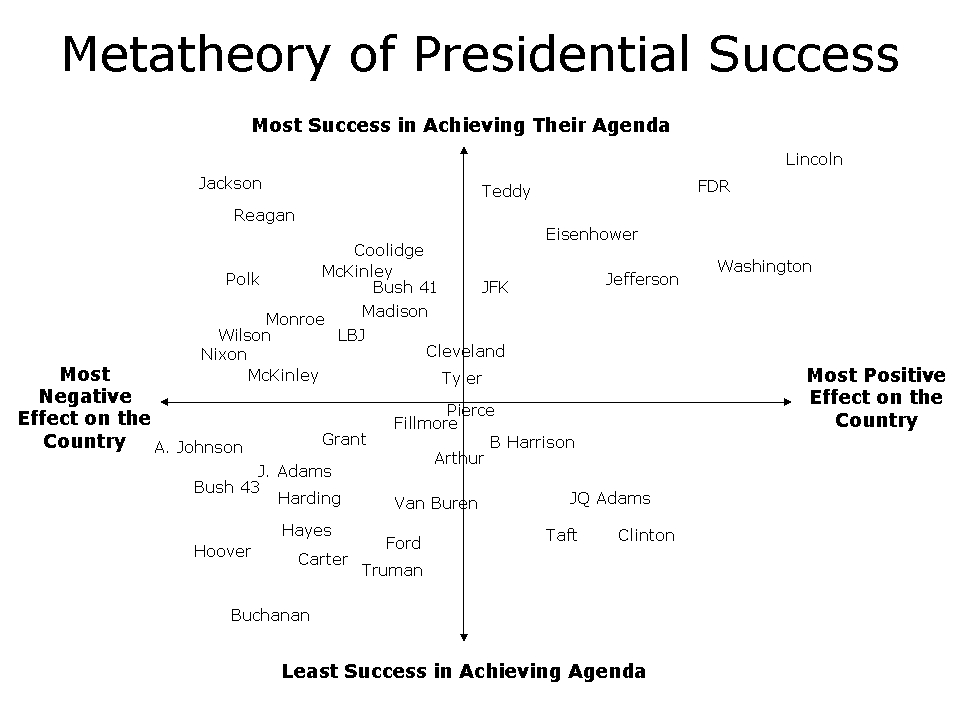
Eminent historian Eric Foner suggests that Bush is the worst President in the history of the country:
Historians are loath to predict the future. It is impossible to say with certainty how Bush will be ranked in, say, 2050. But somehow, in his first six years in office he has managed to combine the lapses of leadership, misguided policies and abuse of power of his failed predecessors. I think there is no alternative but to rank him as the worst president in U.S. history.
I don't know if I'd go so far as to rank Bush below Andrew Johnson, but that certainly does seems to be the league he's playing in.

Thursday, November 30, 2006

Dolchstosslegende

Kevin Drum, on the right's forthcoming effort to airbrush history:
The whole wingnut universe is preparing for another decades-long rerun of Vietnam, in which they pretend that we could have won in Iraq if only liberals and Democrats hadn't poisoned the American will to win.

Wednesday, November 29, 2006

Richard Haass

Richard Haass of the Council on Foreign Relations talks about whether it matters whether or not Iraq is in a "civil war":

It's not simply a semantic issue. If Iraq is seen as in a civil war by the administration, it has all sorts of policy consequences, and it will more than anything accelerate tremendously the drive or the push to get U.S. forces largely out of Iraq. It's not clear U.S. forces have any useful role if, in fact, you think there's a civil war. This is actually a distinction with a difference.

It may not be an all-out civil war, but it sure looks like one. And I would say that Iraq right now is something of a cross or a blend between a civil war and a failed state. What you do not have is effective central authority. You have the growing war between and among militias.

Saturday, November 25, 2006

Naomi Klein, on the postwar plan for Iraq

2+ years later, this is still the best insight on why things went so wrong in Iraq:

The honey theory of Iraqi reconstruction stems from the most cherished belief of the war's ideological architects: that greed is good. Not good just for them and their friends but good for humanity, and certainly good for Iraqis. Greed creates profit, which creates growth, which creates jobs and products and services and everything else anyone could possibly need or want. The role of good government, then, is to create the optimal conditions for corporations to pursue their bottomless greed, so that they in turn can meet the needs of the society. The problem is that governments, even neoconservative governments, rarely get the chance to prove their sacred theory right: despite their enormous ideological advances, even George Bush's Republicans are, in their own minds, perennially sabotaged by meddling Democrats, intractable unions, and alarmist environmentalists.

Iraq was going to change all that. In one place on Earth, the theory would finally be put into practice in its most perfect and uncompromised form. A country of 25 million would not be rebuilt as it was before the war; it would be erased, disappeared. In its place would spring forth a gleaming showroom for laissez-faire economics, a utopia such as the world had never seen. Every policy that liberates multinational corporations to pursue their quest for profit would be put into place: a shrunken state, a flexible workforce, open borders, minimal taxes, no tariffs, no ownership restrictions. The people of Iraq would, of course, have to endure some short-term pain: assets, previously owned by the state, would have to be given up to create new opportunities for growth and investment. Jobs would have to be lost and, as foreign products flooded across the border, local businesses and family farms would, unfortunately, be unable to compete. But to the authors of this plan, these would be small prices to pay for the economic boom that would surely explode once the proper conditions were in place, a boom so powerful the country would practically rebuild itself.

The fact that the boom never came and Iraq continues to tremble under explosions of a very different sort should never be blamed on the absence of a plan. Rather, the blame rests with the plan itself, and the extraordinarily violent ideology upon which it is based.

To see the pervasiveness of this laissez-faire thinking, check out this article on gasoline smuggling in Iraq.

Sunday, November 19, 2006

Kissinger on Iraq

Henry Kissinger, on the prospects for military victory in Iraq:
If you mean by "military victory" an Iraqi government that can be established and whose writ runs across the whole country, that gets the civil war under control and sectarian violence under control in a time period that the political processes of the democracies will support, I don't believe that is possible.
Kissinger always was a charter member of the real[politik]ity-based community, after all.

Thursday, November 16, 2006

Welfare "reform" results, ten years on: more hungry Americans

With the usual GOP-administrator's Orwellian touch:

The number of hungriest Americans has risen over the past five years. Last year, the total share of food-insecure households stood at 11 percent.... The USDA said that 12 percent of Americans -- 35 million people -- could not put food on the table at least part of last year. Eleven million of them reported going hungry at times.

Beginning this year, the USDA has determined "very low food security" to be a more scientifically palatable description for that group.... Three years ago, the USDA asked the Committee on National Statistics of the National Academies "to ensure that the measurement methods USDA uses to assess households' access -- or lack of access -- to adequate food and the language used to describe those conditions are conceptually and operationally sound." Among several recommendations, the panel suggested that the USDA scrap the word hunger, which "should refer to a potential consequence of food insecurity that, because of prolonged, involuntary lack of food, results in discomfort, illness, weakness, or pain that goes beyond the usual uneasy sensation."

Emphasis added.

Optimistically, maybe the fact that the Republicans have decided to redefine hunger as a "security issue" means that they actually intend to do something about it, rather than merely regarding hunger as a bracing incentive for the morally feckless to pull themselves together.

Wednesday, November 15, 2006

Baby Chalabis

From Anatol Lieven and John Hulsman's wonderful Ethical Realism:

Among the enormous numbers of analysts in Washington still employed in the study of Russia, the number who are actually capable of placing themselves in the skins of most Russians can be counted on the fingers of one hand. They themselves, of course, sincerely believe otherwise. But that is because the Russians whom they know well, and feel they understand, have been selected and self-selected to confirm American attitudes and prejudices. Those Russians who disagree just do not get Western grants and jobs, and are not interviewed as "serious" and "objective" sources of analysis by Western journalists.

Mostly, the copulation of illusions is just designed to secure financial and career benefits for the West's local informants. But it also continually lays the U.S. establishment open to manipulation by the likes of Iraqi opportunist and neoconservative darling Ahmed Chalabi for their own political ends. Indeed, several leading Washington think tanks are virtual nurseries for flocks of Baby Chalabis, all mewling into the doting ears of their foster parents about how the freedom-loving people of Ubangi-Gangi or Khakistan love America, support American policies, want America to intervene in their countries to "restore democracy"--and above all, want their beloved Ahmed Junior to get back his old job as minister for corruption. You think we exaggerate? Look at Benazir Bhutto's record in office, and then ask how large parts of the U.S. establishment can possibly believe that her return to power would be good for Pakistan.

From p. 76-77. Read the whole thing.

Microsoft

Redmond, making all the right moves with Zune:
"I've never seen a business so blatantly screw its business partners," says Peter Sealey, a professor at Berkeley's Haas School of Business.

Friday, November 10, 2006

To Wilfred Owen

Tomorrow it will be 88 years since the end of World War One. Wilfred Owen died in combat one week before the end of the war, just eight months after completing the greatest poetic ode to twentieth century warfare:
Dulce et Decorum Est

Bent double, like old beggars under sacks,
Knock-kneed, coughing like hags, we cursed through sludge,
Till on the haunting flares we turned our backs
And towards our distant rest began to trudge.
Men marched asleep. Many had lost their boots
But limped on, blood-shod. All went lame; all blind;
Drunk with fatigue; deaf even to the hoots
Of tired, outstripped Five-Nines that dropped behind.

Gas! Gas! Quick, boys! – An ecstasy of fumbling,
Fitting the clumsy helmets just in time;
But someone still was yelling out and stumbling,
And flound'ring like a man in fire or lime ...
Dim, through the misty panes and thick green light,
As under a green sea, I saw him drowning.
In all my dreams, before my helpless sight,
He plunges at me, guttering, choking, drowning.

If in some smothering dreams you too could pace
Behind the wagon that we flung him in,
And watch the white eyes writhing in his face,
His hanging face, like a devil's sick of sin;
If you could hear, at every jolt, the blood
Come gargling from the froth-corrupted lungs,
Obscene as cancer, bitter as the cud
Of vile, incurable sores on innocent tongues,
My friend, you would not tell with such high zest
To children ardent for some desperate glory,
The old Lie: Dulce et Decorum est
Pro patria mori
.

Wednesday, November 08, 2006

"A little list"

From the Daily Telegraph, good news:

"As the Lord High Executioner said in The Mikado, 'I have a little list'," John Dingell, the veteran Michigan Democrat, said recently.

Mr Dingell, who was first elected to Congress in 1955, earned a reputation as an aggressive chairman of the Commerce Committee during Ronald Reagans's administration. It is a role he intends to play again. Mr Dingell has announced that he plans investigations into everything from the administration's response to Hurricane Katrina to energy policy by way of environmental policy, the Food and Drug Administration, port security, nuclear waste management and trade policy.

Tuesday, November 07, 2006

"Choice": not the same thing as "opportunity"

Tony Woodiwiss:
"Choice" has today replaced "opportunity" at the core of official discourse: "choice," however, merely simulates "opportunity." Although it is spoken of as if it means the same thing, it does not; "choice" is socially safer than "opportunity" in that it carries no implication that anything needs to be equalized and therefore nothing need change as regards the disposition of power or resources; and "choice" is better than "opportunity" in that it is impossible to improve on freedom.

Sunday, November 05, 2006

Quote of the day: Reagan

Ronald Reagan, acceptance speech, RNC, 1980:
Can anyone look at the record of this administration and say, "Well done"? Can anyone compare the state of our economy when the Administration took office with where we are today and say, "Keep up the good work"? Can anyone look at our reduced standing in the world today and say, "Let's have four more years of this"?

Friday, November 03, 2006

Pelosi

The Economist, on Pelosi: "It's like listening to a cross between a Stepford wife and Jesse Jackson." The article blithely assumes the Dems are taking control. I'm not counting my chicken yet.

Wednesday, October 25, 2006

Huntington on Vietnam

Samuel Huntington, in a memo to Lyndon Johnson in December 1967:
History shows that American instincts are usually revolutionary but that our talents are most accommodative.
Available in Box 59, NSF Country File, Vietnam, Johnson Library, Austin, Texas

Thursday, October 19, 2006

Totalitarianism?

In a brief but judicious piece on the history of the idea of totalitarianism, Anson Rabinbach explains (as gently as possible) the two key dangers that liberals face by embracing the notion that the current struggle with Islamic extremism can be usefully analyzed via the word "totalitarianism":
[First,] antitotalitarianism, as I have argued, can both illuminate and obscure. By asserting that totalitarianism encompasses Baathist dictatorship, the Muslim Brotherhood, and al-Qaeda, crucial distinctions are lost. At the same time we are led to believe that, as in the Second World War and the cold war, resolution and military power alone can bring about a democratic outcome. False analogies carry serious consequences.... [Second,] antitotalitarianism, for all its highmindedness, almost always means making a compact with unwelcome allies. Just as the antifascists had to embrace communists during the 1920s and 1930s, just as anticommunist liberals found themselves helpless in drawing boundaries against McCarthyism or against Vietnam hawks, today’s antitotalitarians face a similar dilemma: how to stand their ground against those on the left who wantonly minimize or deny the danger of terrorism and Islamist fundamentalism without at the same time falling into line with the failed neoconservatives whose vision of pax Americana has come to a very bad end.
In other words, there are two basic problems with trying to use the concept of totalitarianism to analyze our current global strategic challenges. First, from a policy perspective, the idea of totalitarianism tends to pave over crucial distinctions which ought to be retained if we are to adopt a properly nuanced strategy in the global struggle against Islamic extremism, on the one hand, and anti-Americanism, on the other. Second, from a political perspective, the antitotalitarian impulse almost always ends up forcing liberals into uncomfortable political coalitions with people they really ought to keep their distance from, be they (neo)McCarthyites or neoconservatives.

To really drive home his point, Rabinbach might have made one additional point, which is that this latter political point is exactly why the Right embraces the concept of totalitarianism: because it undercuts liberals' ability to effectively criticize the Right. So what if the "totalitarian" concept has the collateral effect of screwing up American strategic thinking about our global challenges -- the important thing is that it screws liberals!

Now, I guess I can understand how, if I were a neocon or neoMcCarthyite, I might embrace a concept that while analytically misleading is at least useful for skewering my domestic political enemies. (It's disgusting, but understandable. Then again, one suspects that the reasoning in these circles is actually the reverse: e.g., if it screws my domestic political enemies, then it must be a globally useful theory.) What's completely incomprehensible, however, is why liberals like Paul Berman, George Packer, Ken Pollack or any of the other liberal hawks would themselves embrace a term which is not only analytically pernicious from a policy perspective, but also politically suicidal. The neocons may be knaves, but the liberal hawks are fools.

Tuesday, October 17, 2006

Glamour cities

In an article on San Francisco's architectural deficit, Slate elaborates on the concept of "glamour cities":
Glamour cities are centers of international business (New York), political power (Washington, D.C.), and the New Economy (Boston). They usually have a 19th-century infrastructure of museums, concert halls, and well-preserved residential architecture, and they are where the wealthy, the well-educated, and the ambitious want to live. High-end demand, in turn, produces real estate values that—even in the current slump—are an order of magnitude greater than elsewhere. These cities are vibrant, livable, prosperous, and well-managed.
Washington DC... "well-managed"?! Somewhere, Marion Barry is smiling....

Monday, October 16, 2006

Communities of Practice

Francis Fukuyama:
"Communities of practice..." involve informal sharing of intellectual property based on reciprocity.... In such communities, a great deal of knowledge cannot be formalized (i.e. written down) because it is not possessed by any one individual and only emerges as a consequence of their interaction.

Wednesday, October 11, 2006

The bottom

Frank Stella: "You start at the bottom in New York, and the bottom is pretty bottom-like in New York."

Monday, October 09, 2006

Most surreal moment in Iraq

Peter Devlin, the Marine Colonel who recently filed a secret report claiming that "there is almost nothing the U.S. military can do to improve the political and social situation" in Western Iraq, describes his "most surreal moment" in Iraq:
Watching Marines arrive at my detention facility and unload a truck load of flex-cuffed midgets. 26 to be exact. We had put the word out earlier in the day to the Marines in Fallujah that we were looking for Bad Guy X, who was described as a midget. Little did I know that Fallujah was home to a small community of midgets, who banded together for support since they were considered as social outcasts. The Marines were anxious to get back to the midget colony to bring in the rest of the midget suspects, but I called off the search, figuring Bad Guy X was long gone on his short legs after seeing his companions rounded up by the giant infidels.

Mission Accopmplished: North Korea Edition

It's not an insight, but nevertheless worth repeating, that every single foreign policy action of the Bush regime has blown up in their (and our) faces.

Saturday, October 07, 2006

In honor of Foleygate, tonight we'll be eating...

... Fagioli al Fiasco.

The Proper Objectives and Methods of Social Science

Francis Fukuyama:
It is certainly desirable for a social science to be rigorous, empirical and seek general rules of human behavior. But as Aristotle explained, it should not try to achieve a rigor that goes beyond what is possible given the limitations inherent in the subject matter. In fact, most of what is truly useful for policy is context-specific, culture-bound and non-generalizable. The typical article appearing today in a leading journal like the American Political Science Review contains a lot of complex-looking math, whose sole function is often to formalize a behavioral rule that everyone with common sense understands must be true. What is missing is any deep knowledge about the subtleties and nuances of how foreign societies work, knowledge that would help us better predict the behavior of political actors, friendly and hostile, in the broader world.

Tuesday, October 03, 2006

"Like a gracile wine glass being sung to by a heavy soprano"

Alaskan storm cracks giant iceberg in Antarctica.

4 weeks to go

The NIE saying that Iraq was making the terrorism threat worse didn't outweigh the massive Republican media blitz of the Dems being soft on terror. But apparently the Foley scandal may really cost them: the punters in Iowa just doubled the odds that the Dems will retake at least one chamber.

Saturday, September 30, 2006

"Mission Accomplished" Dept.: Hearts and Minds Edition

BBC:

The US Department of Defense has now provided another measure of the problem it faces. Its latest opinion poll carried out in Iraq indicates that, among the five million Sunni Muslims there, about 75% now support the armed insurgency against the coalition.

This compares with 14% in the first opinion poll the Defense Department carried out back in 2003. It is a catastrophic loss of support, and there is no sign whatever that it can be effectively reversed.

Wednesday, September 27, 2006

LBJ, pt. 2

Marilyn Young, in her amazing synthesis The Vietnam Wars, describes how Lyndon Johnson explained his strategy of gradually ramping up the bombing against North Vietnam in early 1965:
To the popular syndicated columnists Evans and Novack [sic], for example, he "pointed out the targets he had approved for attack and the many more targets he had disapproved." And anybody worried about Chinese intervention, Johnson told the reports, should just relax:
the slow escalation of the air war in the North and the increasing pressure on Ho Chi Minh was seduction, not rape. If China should suddenly react to slow escalation, as a woman might to attempted seduction, by threatening to retaliate (a slap in the face, to continue the metaphor), the United States would have plenty of time to ease off the bombing. On the other hand, if the United States were to unleash an all-out, total assault on the North--rape rather than seduction--there could be no turning back, and Chinese reaction might be instant and total.
Senator George McGovern met with Johnson that same spring to protest the bombing on the grounds that it might lead to Chinese intervention and was almost certain to increase the number of soldiers North Vietnam sent south. Johnson reassured him: "I'm watching that very closely. I'm going up her leg an inch at a time... I'll get to the snatch before they know what's happening, you see."
In case you're wondering: yes, the Novak in question is in fact that same Plamegate Bob Novak.

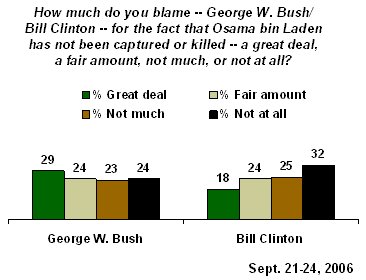
Who's to Blame for not Getting Osama?


From Gallup.

Tuesday, September 26, 2006

LBJ, pt 1

Kevin Drum, in rare form:
Legend has it that during one of Lyndon Johnson's congressional campaigns he decided to spread a rumor that his opponent was a pig-fucker. LBJ's campaign manager said, "Lyndon, you know he doesn't do that!" Johnson replied, "I know. I just want to make him deny it."

A bit of good news

BBC:
A cheap and readily available drug could reverse severe liver disease, even in patients who find it impossible to give up booze, research suggests.

Thursday, September 21, 2006

"Mission Accomplished" Dept.: Torture Edition

UN's chief anti-torture expert says torture in Iraq may be worse now than under Saddam:

Manfred Nowak said the situation in Iraq was "out of control", with abuses being committed by security forces, militia groups and anti-US insurgents.

Bodies found in the Baghdad morgue "often bear signs of severe torture", said the human rights office of the UN Assistance Mission in Iraq in a report.

The wounds confirmed reports given by refugees from Iraq, Mr Nowak said.

He told journalists at a briefing in Geneva that he had yet to visit Iraq, but he was able to base his information on autopsies and interviews with Iraqis in neighbouring Jordan.

"What most people tell you is that the situation as far as torture is concerned now in Iraq is totally out of hand," the Austrian law professor said.

"The situation is so bad many people say it is worse than it has been in the times of Saddam Hussein," he added.

The UN report says detainees' bodies often show signs of beating using electrical cables, wounds in heads and genitals, broken legs and hands, electric and cigarette burns.

Bodies found at the Baghdad mortuary "often bear signs of severe torture including acid-induced injuries and burns caused by chemical substances".

Many bodies have missing skin, broken bones, back, hands and legs, missing eyes, missing teeth and wounds caused by power drills or nails, the UN report says.

Victims come from prisons run by US-led multinational forces as well as by the ministries of interior and defence and private militias, the report said.

The most brutal torture methods were employed by private militias, Mr Nowak told journalists.

The report also says the frequency of sectarian bloodletting means bodies are often found which "bear signs indicating that the victims have been brutally tortured before their extra-judicial execution".

It concludes that torture threatens "the very fabric of the country" as victims exact their own revenge and fuel further violence.

Mr Nowak said he would like to visit Iraq in person, but the current situation would not allow him to prepare an accurate report, because it would not be safe to leave Baghdad's heavily guarded Green Zone where the Iraqi government and US leadership are situated.

The "failure of execution" myth exposed

Anatol Lieven, on how liberal hawks are just more confused versions of the neocons:

Michael Signer's essay is yet another in an all-too-numerous list of recent works by center-left intellectuals arguing that America can recover from its present international difficulties by changing the style of its approach to the world without significantly changing its policies. He denounces the "vulgar exceptionalism" of the neoconservatives and the Bush Administration but does not realize that we are well past the days when a tonier, more agreeably phrased American exceptionalism could command real support from most of the rest of the world. Signer's argument reflects the fact that, in the end, by far the greater part of the Republican and Democratic establishments share the same basic myths of American nationalism concerning the righteousness of American power, the same commitment to U.S. supremacy in the world, and a common adherence to the same set of basic imperial strategies. And until progressive foreign policy thinkers confront these myths, they only will offer up alternative slogans or tactics but nothing resembling a foreign policy vision.

Take Signer's supposed alternative to the failed policies of the Bush Administration, "exemplarism." He writes, "[In today's globalized environment], it is simply impossible for any country, even one as powerful as the United States, to ignore or neglect its interconnections with other nations." At the same time, Signer is a strong believer both in America’s superpower status and in innate American virtue: What he calls "the ineluctable attractions of [America's] own unique capabilities and goodwill–by the charisma of its own great character...."

Signer does not seem to appreciate that, like any other country... America is judged by others not just on its present actions and declarations, but on its past record. If, as he himself says, the recent record of the United States has been so awful, why should other countries automatically trust America in the future? Like so much of the U.S. foreign policy establishment, Signer fails in what Hans Morgenthau laid down as one of the most fundamental virtues of true statesmen: The ability to put themselves in the shoes of other countries.

Signer declares that "exemplarism would value both strength and international prestige equally, seeing them not as mutually exclusive but rather as mutually reinforcing" and that "America's economic, political, and military strength, when deployed wisely, enhances our prestige around the world." Who could possibly disagree? But, once again, what does "deploying American strength wisely" actually mean in practice? And who gets to decide what is "wise"? Is it America alone, or do American allies get a real say when it comes to designing and changing American policies? Without a real willingness to change American policies, it may be possible to bring about the kind of sullen acquiescence to the United States that one sees at present in Western Europe, for example, but it will be quite impossible to get nations outside that sphere to make real sacrifices for the sake of those policies and thereby lighten the present unsustainable burden on American resources. It is easy to talk of a need for more diplomatic approaches by the United States, and it is true that leading members of the Bush Administration have been notoriously and dangerously contemptuous of the very idea of diplomacy. But the liberal hawks who praise diplomacy in principle also appear to misunderstand its true nature. When they speak of engaging other countries diplomatically, what they usually mean is talking at them more loudly and sweetly, but with the same ends in mind. True, this has always been a key feature of diplomacy. But real diplomacy also means a recognition of other states' vital interests and a willingness to reach compromises accordingly. This, by contrast, is too often called–by Democrats as well as Republicans–"accommodation" or even "appeasement."

The weakness of Signer's approach is exemplified by his treatment of the Iraq war. As with so many of his Democratic colleagues, he wriggles out of saying whether the war itself was a good or bad thing. Instead, he suggests that if only the Bush Administration had diplomatically enlisted European help, what happened in Iraq would have been very different. This is arrant nonsense. The Europeans were never going to be able to give serious help to the United States in Iraq. They have no effective military help to give, and their readiness to make financial sacrifices was always going to be severely limited by the–entirely correct–opinion of European policymakers and electorates that the whole U.S. strategy was fundamentally misguided.

Wednesday, September 20, 2006

Cracking the code

Turns out Hezbollah just flat beat the Israelis, militarily:

Hezbollah guerrillas were able to hack into Israeli radio communications during last month's battles in south Lebanon, an intelligence breakthrough that helped them thwart Israeli tank assaults, according to Hezbollah and Lebanese officials.

Using technology most likely supplied by Iran, special Hezbollah teams monitored the constantly changing radio frequencies of Israeli troops on the ground. That gave guerrillas a picture of Israeli movements, casualty reports and supply routes. It also allowed Hezbollah anti-tank units to more effectively target advancing Israeli armor, according to the officials.

"We were able to monitor Israeli communications, and we used this information to adjust our planning," said a Hezbollah commander involved in the battles, speaking on the condition of anonymity. The official refused to detail how Hezbollah was able to intercept and decipher Israeli transmissions. He acknowledged that guerrillas were not able to hack into Israeli communications around the clock.

The Israeli military refused to comment on whether its radio communications were compromised, citing security concerns. But a former Israeli general, who spoke on the condition of anonymity, said Hezbollah's ability to secretly hack into military transmissions had "disastrous" consequences for the Israeli offensive.

"Israel's military leaders clearly underestimated the enemy and this is just one example," he said.

The Great Lie

Joan Didion on Dick Cheney:

If the case for war lacked a link between September 11 and Iraq, the Vice President would repeatedly cite the meeting that neither American nor Czech intelligence believed had taken place between Mohamed Atta and Iraqi intelligence in Prague: "It's been pretty well confirmed that [Atta] did go to Prague and he did meet with a senior official of the Iraqi intelligence service in Czechoslovakia last April, several months before the attacks," he would say on NBC in December 2001. "We discovered...the allegation that one of the lead hijackers, Mohamed Atta, had, in fact, met with Iraqi intelligence in Prague," he would say on NBC in March 2002. "We have reporting that places [Atta] in Prague with a senior Iraqi intelligence officer a few months before the attacks on the World Trade Center," he would say on NBC in September 2002. "The senator has got his facts wrong," he would then say while debating Senator John Edwards during the 2004 campaign. "I have not suggested there's a connection between Iraq and 9/11."

This was not a slip of memory in the heat of debate. This was dishonest, a repeated misrepresentation, in the interests of claiming power, so bald and so systematic that the only instinctive response (Did too!) was that of the schoolyard. By June 2004, before the debate with Edwards, Cheney had in fact begun edging away from the Prague story, not exactly disclaiming it but characterizing it as still unproven, as in, on a Cincinnati TV station, "That's true. We do not have proof that there was such a connection." It would be two years later, March 2006, before he found it prudent to issue a less equivocal, although still shifty, version. "We had one report early on from another intelligence service that suggested that the lead hijacker, Mohamed Atta, had met with Iraqi intelligence officials in Prague, Czechoslovakia," he told Tony Snow on Fox News. "And that reporting waxed and waned where the degree of confidence in it, and so forth, has been pretty well knocked down at this stage, that that meeting ever took place. So we've never made the case, or argued the case, that somehow [Saddam Hussein] was directly involved in 9/11. That evidence has never been forthcoming."

Tuesday, September 19, 2006

Sleepwalkers

Mark Lilla, in TNR Online, on the domestic political scene since 9-11:

I do not recognize my country today. It walks, it talks, but its eyes are glassy and vacant. I am not one of those who blames the Bush administration for this; our government is a symptom of our condition, not its cause. Several thousand people died in the attacks of September 11, but the changes in our political atmosphere that followed bear little understandable relation to the emotions of mourning, rage, revenge, or even fear. Objectively seen, those attacks did nothing to change the balance of power in the world, as an invasion or assassination might have. The bastards got lucky; that is all. But, like a trauma victim who suddenly sees his surrounding environment as alien and hostile, the United States reacted to those events by disengaging itself from reality, internationally and domestically. Mental disengagement combined with military engagement--a recipe for disaster....

[After] the planes struck, what happened next on the international scene is a matter of public record. What happened within the United States is less well understood abroad. To hostile foreign observers, the United States has simply reverted to type, revealing its true face as a brutal imperialist monster. From the outside, it looks like we are being driven by greed for oil, or hatred of Muslims, or blind loyalty to Israel, or contempt for the international community---we know the litany. From the inside, the last five years of U.S. history look very different. We are still a nation in shock--hardly capable of conceiving an imperial strategy, let alone pursuing it. That is why we still have no real strategy for dealing with the genuine threat of radical Islam, or for securing our cities and ports. When the decision to invade Iraq was being made, there were long, serious debates in the British House of Commons, which anyone with a satellite dish could watch on BBC. No such display could be found on U.S. television because no such debate took place in the U.S. Congress. The president was given carte blanche. And American reporters, like adolescents at play, donned military uniforms and joined the troops as "embedded" observers, gushing over the display of firepower. The nation slept.

While it slept, the clock of U.S. politics turned in reverse, back to the mindset of the cold war and the culture wars of the '60s and '70s. All sorts of strange types emerged from under their rocks to exploit September 11--neoconservatives longing for a war that would restore "American greatness" through militarism, legal anarchists who started rewriting the constitution, evangelicals who sensed the opportunity to launch a counter-revolution against all the cultural changes of the last four decades. None of these groups represented more than a fraction of Americans, but, together, they found the ear of a transformed president and of his political advisers, who knew how to exploit them in return. The level of American political debate sank to a new low and is now fixed on symbols--"values," "strength," "family," "security," "life," "freedom"--that bear little relation to contemporary American reality or the world situation. The '90s were a period of political maturation in United States, but, in the face of trauma, the nation has regressed to an infantile state. That includes Bush's many critics, who peddle Vietnam-tinged fantasies of a new antiwar movement and hope to revive adversarial press of the Watergate era. A reader of U.S. newspapers can be forgiven for thinking he is living in 1973.

This week will be taken up with commemorations of those who lost their lives on September 11, as it should be. But, when those ceremonies are over, we should also observe a moment of silence for the America that existed just before that September morning, and which now lies in a coma. We are destined to see that America again, if only because reality has a way of intruding into even the deepest sleep. But the wake-up will be hard. An entire nation will find itself on the floor, its knees bruised, its nose bloodied, the furniture in disarray, wondering just what the hell happened.

Monday, September 18, 2006

Liberal lies

The worst lie that liberals tell about Bush's Middle East policy is that everything in Iraq might have turned out great if only we'd appointed "competent" people. This is a cornerstone of the "incompetence" meme regarding the Bush administration, one rooted in a (quite justified) outrage at the cronyism and stupidity of the current regime.

In the case of Iraq, however, this meme supports the dangeous illusion that the problem with the war was one of execution, rather than ideology and aim. Alas, not even the most competent administrators in the world could have made the postwar in Iraq succeed. This is why the invasion was, to paraphrase Talleyrand, "worse than a crime; it was a blunder." While the White House may be filled with knaves, in the case of Iraq, the knaves were also fools.

The Scientific Method, Government Edition

Friday, September 15, 2006

Peanut butter

Kids these days:
As Flavorpill’s film editor, Rosman contributes to all the city publications, and she has developed a feel for the subtle regional differences. "Chicago has its own kind of hard-core R.&B.-inspired scene and an art scene inspired by both the Art Institute of Chicago and cheaper rents. L.A. has a refracted neon palm tree glam, which is a reaction to all that Hollywood veneer that wends its way into visual art especially, but also into music and all the retro-movie houses. London, well those kids have a jaunty charm I've yet to pin down."

Thursday, September 14, 2006

How to rank Presidents


We've reached the point in George W. Bush's presidency where one can begin to think about where he will rank in the historical annals. The question of ranking Presidents is of course a vexed one, and an inherently political one -- how you weight his political versus his personal characters, his foreign versus his domestic policy, and so on, is by its nature subjective. My own effort to plot Presidential success is above, and I think the axes speak for themselves. The question is, how successful was the President on his own terms, versus the (alas, totally separate) issue of how much good or bad he did for the country.

The Washington Post today, has a slightly different take.

Wednesday, September 13, 2006

Iowa Futures Market on Midterms

The Iowa Futures Market as of yesterday was reading the midterms about like this:
  • GOP retains control of both chambers: 44% chance
  • GOP keeps Senate, Dems win House: 39% chance
  • Dems win Senate, GOP keeps House: 5% chance
  • Dems win both chambers: 12% chance

Tuesday, September 12, 2006

Squandering bipartisanship

Keith Olberman:

Terrorists did not come and steal our newly-regained sense of being American first, and political, fiftieth. Nor did the Democrats. Nor did the media. Nor did the people.

The President -- and those around him -- did that.

They promised bi-partisanship, and then showed that to them, "bi-partisanship" meant that their party would rule and the rest would have to follow, or be branded, with ever-escalating hysteria, as morally or intellectually confused, as appeasers, as those who, in the Vice President's words yesterday, "validate the strategy of the terrorists."

Monday, September 11, 2006

Islamism in Sudan

From George Packer, "Moderate Martyr: Interpreting Islam for the modern world," New Yorker, September 11, 2006:
The Sudanese version [of Islamism] was not a genuine revolution like the Iranian one; it was more of an elite project that never gained legitimacy outside of student, intellectual, and military circles. Still, Sudan's hard-line party, the National Islamic Front, marched the country through familiar paces. Suliman Baldo, the director of the Africa program at the International Crisis Group, who lived through the years of Islamization in Khartoum and published a report documenting the return of slavery in Sudan, said of the government, "They came with a social-engineering project--they were very open about this." Education became a form of indoctrination: small children learned jihadist chants; school uniforms were replaced with combat fatigues; students engaged in paramilitary drills and memorized the Koran; teachers overhauled the curriculum to focus on the glory of Arab and Islamic culture. Khartoum had been a socially relaxed city that celebrated Christmas, but now the morals police insured that women were veiled, especially in government offices and universities. The security agencies were taken over by Islamists, and torture chambers known as "ghost houses" proliferated in what had been a tolerant political culture.... And so an ethnically and religiously mixed African country, with an egalitarian form of Sufism as its dominant form of Islam, was mobilized by intellectuals and soldiers to create a militaristic, ideologically extreme state whose main achievements were civil war, slavery, famine, and mass death.
Authoritarian High Modernism: Islamist Edition.

What's more, just substitute "Christian" for "Muslim" and "American" for "Arab" and you pretty much have the scenario the Christian Right dreams of for our own country.

Friday, September 08, 2006

"Mission Accomplished" Dept.: Talibanistan Edition

Christian Science Monitor, rounding up the news on the "peace deal" in the Northwest Frontier of Pakistan:
In a move that some say appears 'a total capitulation' to pro-Taliban forces, Pakistan signed a peace deal with tribal leaders in the North Waziristan region of Pakistan Tuesday, and is withdrawing military forces in exchange for promises that militant tribal groups there will not engage in terrorist activities.
Read the whole thing. Lots of amazing links.

Wednesday, September 06, 2006

Cosmopolitanization

From Ulrich Beck, Cosmopolitan Vision:

The thesis of this book may be summarized as follows: cosmopolitanization means the disappearance of the closed society for good. But this is not felt by liberation by most people, who instead see their world in decline. People who have succeeded with great difficulty in orienting themselves in the labyrinths of a closed society based on sharp oppositions between us and them, inside and outside, national and international, are now suddenly faced with the contradictions of a tolerant form of society and a liberty they can neither comprehend nor live wit, which reduces them to strangers in their own land....

Anti-cosmopolitanism, whether understated or vociferous, right- or left-wing, union- or church-driven, strictly speaking acts in an anti-national fashion because it is tantamount to a clinical loss of reality and hence betrays the interests of the nation in a global age. The economic, cultural and political challenges and contradictions of globalization cannot be conjured out of existence because we do not like reality and refuse to accept it -- on the motto 'Globalization? I'm against it!' The falling of leaves in autumn can't be prevented by looking the other way, and certainly not by insisting that you hate winter.

P. 108-9, 117; italics in the original; boldface mine.