Wednesday, November 07, 2007

Break Through

I had the pleasure last week of attending a talk by Ted Nordhaus and Michael Schellenberger, the authors of what may be the most significant book on environmentalism of the last several years, Break Through: From the Death of Environmentalism to the Politics of Possibility. Their argument, in a nutshell, is that American environmentalism's main mode of discourse, namely catastrophism, is fundamentally counterproductive since it causes people to despair and turn inward, and that therefore if we want to actually galvanize people to take action on environmental matters, we need to stop talking as if there is an unbreakable choice between environmental catastrophe and limited growth.

Their views on this have been shaped by years of polling research in many countries, and above all in North America, which has convinced them that the way the American environmental movement has gone about its business since the 1970s has been worse that ineffective. As a simple matter of political rhetoric, I think their argument is not only profound, but virtually unimpeachable. Americans never have and never will respond politically to be being told they are sinners who must repent, in this case, from the sin of consumerism. Even more, the Chinese will never accept that they too should restrain their growth, as if freezing the current wealth levels of different countries is remotely fair.

I chatted briefly with Michael after the talk, and handed him my paper, which he had some kind words about on his blog yesterday:
Gilman, Doug Randall, and Peter Schwartz come to very similar conclusions about how the political reactions to climate change might divide the environmental community, just as immigration reform and Cape Wind divided the Sierra Club.
[C]limate change may form the basis for a new set of political coalitions and oppositions that do not fit within the [traditional left-right] political paradigm. One possibility is that political coalitions and parties may be reformed around different attitudes to social risk-sharing, with one faction opting for having the state take an activist approach to mitigating a variety of "big" security risks (military, terrorist, environmental) and another coalition forming around allowing people to fend for themselves, with a less intrusive but also less protective state. The recent debate in the Sierra Club over the organization's stance on immigration presages such a formation, as does the current debate in Europe about "repatriation" of immigrants.
The initial reaction from some people to Break Through was that we constructed a straw man, as though to say, Come on, there's hardly any environmentalists any more who are anti-growth, limits-based, NIMBY, or anti-immigrant.

These claims were often followed, without any apparent sense of irony, by the insistence that technology can't solve our problems, there are natural limits to economic growth, and there's not enough room on lifeboat Earth for everyone to live the way we live in the developed world.

Having spent the last month traveling around the country on book tour, Ted and I have been struck that the biggest objection audiences have to our book is our contention that there's room for all 7 billion of us Earthlings to live prosperous, free and fulfilled lives. We point out that this won't be the case if we continue on the current fossil fuel trajectory -- hence the need for a politics that gets us off it -- but if we move to a clean energy economy, live mostly in cities, and begin to restore the nonhuman ecosystems we depend on, there's no reason to believe the levels of prosperity we enjoy shouldn't be achieved by everyone.

Ever since Malthus in the early 19th Century (and likely well before that) people have been predicting that we're going to run out of food. Their calculations are always impeccable. The problem is that they're based on existing technologies. And technological innovation is what our species excels at.

The new political fault line we see shaping up is between a large politics (what we call "greatness") characterized by a vision for growth, development, globalization, and non-zero sum thinking (i.e., "win-win") -- and a small politics characterized by NIMBYism, anti-immigrant attitudes, the resistance to what GBN calls "social risk-sharing," and the sense that there's only so much planet Earth to go around.

Which side will prevail? GBN says it's uncertain. "While ecosystems have always been dynamic and changing (and subject to collapse), the scientific ability to track such collapses, and the media visibility of such collapses, is far greater than it has ever been. How the global public will react to such collapses is largely unknown."

GBN makes the very good point that as human systems collapse, humans "rely upon primary loyalties (families, neighborhoods, religious organizations, gangs) for daily survival.... Those unwilling or unable to profit from the chaos will radiate outward through refugee flows, exporting social conflicts to adjacent locales."

What I thought was missing from the GBN analysis was an acknowledgment of the fairly extensive research of how discourses of collapse and apocalypse feed the small, authoritarian, and NIMBY political reaction -- not the expansive, democratic, and ecological one.
I think that critique of our work from last year is fair. We could have sharpened the analysis by suggesting that political discourses themselves are semi-independent variables that help determine political outcomes. One thing I learned from Nordhaus and Schellenberger is that an important indicator to watch for is the optimism or pessimism of the political narrative about climate. (People have been ignoring jeremiads since, well, Jeremiah.)

If I have a criticism of Nordhaus and Schellenberger, it is not on the substantive matter of how the politics of environmentalism should be framed. I agree strongly with them that environmentalism is most likely to succeed as a political matter if it is not positioned as a matter of restriction, but rather as an opportunity. Nor do I disagree in the slightest that from a policy perspective, it would be fantastic for the US federal government to initiate a major push to create infrastructure that can provide a "platform for green innovation" (modeled after, for example, the federal investment in the Tennessee Valley Authority in the 1930s-40s, the Interstate system in the 1950s-60s, or the Internet in the 1970s-1980s) -- which would provide enormous business opportunities. Finally, I also agree that any viable solution to the global warming challenge must include a calculus for how we can get the rest of the world rich, too. If the solution requires keeping the Indians and Chinese down, it won't work.

Rather, what I disagree with them about is whether what they propose, even if seized upon by a visionary politician who sells it to the American and global public, can happen fast enough to save the planet from environmental catastrophe. Embedded in their work is a faith in the Environmental Kuznets Curve (EKC), that is, the idea that environmental values begin to appear as people hit a certain level of income. They seem to argue that with better framing of the political discourse, we may be able to bring down the price point at which people begin to value more environmentally-friendly policies and consumer habits. There are three main criticisms of the EKC idea. First, it's not clear that people actually do value environmentally-friendly policies as they get richer -- it's just clear that they start to insist that these polluting industries get moved overseas. Yes, the Taiwanese cleaned up as they got wealthier, but they did so by shipping their nastiest facotires across the Straits to China. The Chinese really have no such option, and in any event, even if they did, it wouldn't reduce the global pollutant load for them to do so as they got richer. Second, it seems that the income-threshold at which people start to care about greenhouse gas emissions may be somewhere around $75K per family. Needless to say, China's nowhere close to that, and the amount of pollution it will emit before it gets there is staggering, and likely catastrophic at a planetary level. Third, and most profoundly, the theory of the EKC rests on a general theory of modernization, and specifically on the notion that modernization spells convergence in terms of political values. Readers of this blog probably don't need to be told how skeptical I am of such theories, in particular the idea that people's social and political values are somehow a dependent variable in relation to their economic status, or that political liberalism is the foreordained outcome of the modernization process.

With that said, I think the Nordhaus and Schellenberger have written a great book, one that points the right way forward, even if it may not be enough to save us.

Tuesday, October 30, 2007

5 catastrophe scenarios for the US economy

New York magazine has a pretty dire reading of how the US economy could go down in flames. People will call it a black swan when it happens, but it's anything but. The funniest bit is this:

The bulls will tell you that foreign governments understand the American economy is the key to global economic health, and that they'll suck it up and take it when we devalue their debt. To which Schiff offers another analogy. Imagine if five people were washed up on a desert island: four Asians and an American. In splitting up their duties, one Asian says he'll fish; another will hunt, another will look for firewood, and another will cook. The American assigns himself the job of eating.

"The modern economist looks at this situation and says the American is key to the whole thing," says Schiff. "Because without him to eat, the four Asians would be unemployed."

Friday, October 26, 2007

Black Swans of the Future

Over at Global Guerillas, John Robb has some interesting comments about global security and peak oil. But he kinda wound me up this morning with his off-the-cuff suggestion that the current mortgage crisis exhibits all the hallmarks of a black swan (that is, an event that defies prediction, but it is usually obvious in hindsight):
The financial carnage -- hedge fund failures, bank runs, credit tightening, and potentially a recession -- due to the current mortgage crisis demonstrates (yet again) that very smart people can do incredibly stupid things. For all of the insight, experience, and knowledge we gained through previous financial failures, we still walked blithely into the gaping maw of the delinquencies, defaults, and outsized bailouts that characterize a financial black swan.
I think this is a total misreading of the current mortgage situation. In fact, many people over the last few years have observed -- often in the same breath -- that (1) the relaxation of credit terms for the poor invariably winds up in a credit crisis, and (2) the global housing market was exhibiting every sign of a bubble. The only thing that might arguably have been a surprise is how badly people had priced the CDOs, and how illiquid the markets for these vehicles were. (Even that was pretty obvious to the folks involved in creating those products.) That's the triple play that led to this summer's financial crisis: lax credit terms for the poor, a housing bubble, and untested financialization. Anyone could have -- and a lot of people did -- predict that this mix was unlikely to have a happy ending. So, let's not call it a black swan when what we have here instead is the classic American mix of privatization of profit and socialization of costs. The charade of acting like all this was unpredictable is simply a ruse to make the bailout of bankers politically palatable.

What other future alleged Black Swans can we debunk in advance? Let me put on the record some other big, bad events that we can already see coming, and that no one ought to get away with acting shocked about when they do:
* A rapid, messy collapse in the US dollar
* A major inflationary episode in China
* A major global recession, deepened by populist anti-trade reactions
* The detonation of a nuclear device in a major global port
* All four of the above simultaneously....

When these things happen, some people will be tempted to call them Black Swans. They will base that claim narrowly, citing the particular way the event was precipitated, and the fact that certain smart were caught with their pants down, as "proof" that the event in question was "unpredictable."

But as overall categories of happening, I think these -- like the long-predicted popping of the housing bubble -- are not black swans, but more like "inevitable surprises." The particular way in which the event will come about will be unpredictable and revealing of mass complacency, but the chance that at least one of these events will take place in the next decade strikes me as better than even. In fact, the wonder with all of those events is that they haven't happened already. Of course they'll take people by surprise when they happen, but that doesn't mean they are surprising in the stricter epistemological sense that Taleb uses the term "Black Swan."

Bottom line: Just because the public or some individual is complacent, doesn't mean that the bad stuff that happens to them was a Black Swan.

U.S. housing slump = disaster for Mexican economy

Here is an important and underreported story: the housing slump in the U.S. is causing economic catastrophe in Mexico.

Housing starts have long considered the best single indicator of future economic growth -- it employs a bunch of people, who cycle money through the economy, and it creates a lot of demand for building materials, which has multiplier effects on the wider economy. (It's also a harbinger of inflationary pressure.) All this has led people to ask, "How is it that a collapse in the construction industry over the last year, brought on by the popping of the housing bubble, hasn't rippled out to the rest of the economy?"

Well, the article above provides a partial answer to the mystery. It turns out that the construction slump has rippled out to the rest of the economy -- it's just that "the rest of the economy" is in Mexico. The reasoning goes like this: Mexicans (legal and otherwise) overwhelming dominate the rank and file of building trade in the United States. These construction workers never spent more than the minimum necessary here to keep body and soul together, and instead remitted as much money as possible back home to Mexico. As the construction workers have lost work, they've stopped sending remittances home, with disastrous consequences in Mexico. However, they still have to spend the minimum here in the U.S. to keep themselves together, and so the collapse has had little impact on US consumer demand. To put it a little more technically: all the marginal consumer-side costs of the U.S. construction slump are being felt in Mexico, not in the U.S.

This helps explain half the mystery of why the construction slump hasn't hurt the economy more -- the consumer-side part of the story. The part that's still a mystery, however, is why the construction slump isn't causing more of a collapse in supplier industries (metals, concrete, electrical cable, Home Depot, etc).

Thursday, October 04, 2007

Precarious Living, Dhaka

The Dhaka slums... definitely ready for that next typhoon.

Saturday, September 22, 2007

What would the French say?

I was driving along a road in northern Virginia on Thursday when I saw this giant political advertisement, which pretty much sums up what the Republicans have done to the country for the last six years:In case you think this is a joke, here's this guy's campaign site.

If this posting makes no sense to you, this link may help.

Tuesday, September 18, 2007

Comando Vermelho video

A great video on one of the gangs in the Rio de Janiero slums that is directly challenging the police power of the state.

Money line: "First is God, then my gun."

Best movie line ever: "I'm gonna get medieval on your ass"

Sunday, September 16, 2007

Arctic sea ice update

It's the end of the summer in the Arctic, and guess what? Sea ice is a third lower than ever before recorded. But you know what they say: in every crisis, an opportunity.

Thursday, September 13, 2007

Hurricane Humberto

Hurricane Humberto isn't making much news, because it's only a Category 1 storm, and it's not expected to cause all that much damage. But there's a wrinkly to the Humberto story that's worth paying attention to:
Texans went to bed Wednesday night expecting to be struck by a tropical storm. They awoke to find they'd been hit by a hurricane instead.

The stunningly fast buildup of what became Hurricane Humberto shocked scientists, some of whom said there was nothing like it in the historical record.

In just 18 hours, Humberto strengthened from a tropical depression with 35-mph winds to a Category 1 hurricane with 85-mph winds before crashing ashore. It did not grow into a hurricane until after midnight.

"That has never before happened" in the more than 150 years scientists have been tracking hurricanes in the Atlantic Ocean, said James Franklin, a senior specialist at the National Hurricane Center in Miami.
"That's never before happened...": words worth thinking about. The truth is that the consequences of such a rapid warming as we are imposing on the planet via GHG emissions are really unknown. All sorts of things that are "outside the realm of the possible" within current climate models are going to happen.

Wednesday, September 12, 2007

Who are the real "traitors"?

Glenn Greenwald has an acute column up about the MoveOn advert that rhymes General Petreaus's name with "Betray Us," in which he points out the deep hypocrisy of those on the right who claim it is outrageous to use such a word.
The only difference this time... is that it [the "traitor" rhetoric] is being directed at the side that typically wields such accusatory rhetoric, rather than by them.
This is absolutely correct. Accusing Democrats not just of cowardice or dereliction of duty but of betrayal, traitorship, and treason has been a central staple of the Right's political rhetoric and energy for seventy five years (since March 4, 1933, specifically).

But ask yourself: who is the real traitor: the person who sees that the country has only bad choices before it, acknowledges this, and is willing to make the painful and difficult decision? Or the person who insists on continuing to squander the blood of young Americans, the fortunes of our treasury, and the ability of the country to act in its own interests in other arenas -- merely to retain a prayer of salvaging his own personal reputation?

I tend to agree with Juan Cole that Petreaus is a good soldier stuck in a terrible position, trying to salvage a disaster. With that said, I think it is not wrong to call his political masters in the White House (and the GOP generally) traitors. They are traitors, that is, if by "traitor" we understand someone who knowingly betrays the interests of his country in order to promote his own interests.

At this point only a knave or a fool would fail to realize that staying on in Iraq is contrary to the national interest. The only reason that Bush and the GOP continue to do so is to retain hope that their political reputation can be salvaged. And that, I believe, can rightly be called treasonous.

Tuesday, August 28, 2007

The oblique nature of the impact of climate change

One of the things I've hammered on about this year regarding the impact of climate change is how many of the impacts of climate change will not be reported in the newspaper as impacts of climate change, but rather as political or social crises. In fact, there has even been an explicit push to stop people from even trying to connect political crises to climate change. When UN Secretary General Ban Moon-Ki argued in June (citing the arguments my friend Stephan Faris made in the Atlantic Monthly last year) that climate change was exacerbating resource conflicts in Darfur that drive the slaughter going on there, Idean Salehyan shot back in Foreign Policy that blaming the situation in Darfur on climate change in effect was letting the politicians in Khartoum off the hook. You can judge Salehyan's arguments on their merits, but what is certain is that insofar as people embrace his perspective that proximate political causes should always have explanatory and moral priority over background long duree causal factors like climate change, it will be impossible to really create any political consensus about the impact of climate change.

As I was trying to figure out why this is so, it occurred to me that the impact of climate change can perhaps best be thought of as an inversion of the genius marketing slogan of the chemical company BASF: "We don't make a lot of the products you buy. We make a lot of the products you buy better." In the case of climate change, you might say, "Climate change doesn't make problems. It makes a lot of the problems you have worse." And that seems to about right for describing the impact of climate change in Darfur, and also underscores why climate change, short of the most catastrophic scenarios, is unlikely to be a big problem in places which are otherwise politically, socially, and economically healthy. In places that are already stressed, however, climate change will ratchet up the leverage, and in some instances will function as the proverbial last straw, precipitating political, social, and economic collapses, that will be reported as such.

Saturday, August 25, 2007

Anne-Louise, 1923-2007

My grandmother died today, or maybe it was tomorrow, I don't know.

The last time I saw her was in 2005 in Copenhagen. I saw her half a dozen times since I moved back from Europe ten years ago, and I was acutely conscious every time I departed from her that this was very possibly going to be the last time I would see her, and I tried for that reason to make a mental image of the moment. So the last time was at her flat, overlooking the Oresund, and we sat and had tea and talked about my children and my work. She quickly became tired, so I had to go.

It's self-indulgent to feel existential when someone close to you dies. Or perhaps the self-indulgence of the existentialists was to go around cultivating as a constant personal style that feeling you have when someone close to you dies. Still, the existentialists have all the good quotes that describe the feeling of limitation that death brings home, and also the struggle to deny those limitations. One of my favorite expressions of this, which for some reason came to me today, is from Paul Bowles's The Sheltering Sky:
Because we don't know when we will die, we get to think of life as an inexhaustible well. Yet everything happens only a certain number of times, and a very small number really. How many more times will you remember a certain afternoon of your childhood, an afternoon that is so deeply a part of your being that you can't even conceive of your life without it? Perhaps four, five times more, perhaps not even that. How many more times will you watch the full moon rise? Perhaps 20. And yet it all seems limitless.
It all seems limitless, but it's not. Which is why the most important thing is to keep one's own moral compass in good order every day, and without exceptions. Because soon it will all be over, and all that will matter, really, is whether you maintained that compass. And one thing I can say without the slightest equivocation is that keeping such compass was something my grandmother did as effectively as anyone I have known, and she did so without ever being sanctimonious.

Requiescat in pace, Mormor.

Times gets my story, two days later

Following on my posting from three days ago, the Times of London, a Rupert Murdoch outfit, explains the "revisionism" that lies behinds Bush's claims about Vietnam. It's Sorley and Moyar alright, as well as their various readers in Bush regime. Money:

In Triumph Forsaken, published last year, the historian Mark Moyar claimed that South Vietnam could have survived had the Americans not acquiesced in the overthrow of President Ngo Dinh Diem in 1963, plunging the country into an “extended period of instability and weakness”.

Moyar is now working on a book about the second half of the war, in which he argues: “In the offensive of 1975, the North Vietnamese are moving around huge conventional forces that would have been pulverised by our air power.” By then, however, Hanoi was well aware that America was turning against the war and doubted that the US military would be able to act decisively.

Supporters of the Iraq war have also been delving into Lewis Sorley’s book, A Better War, which was rereleased in paperback this year. The war, Sorley wrote, “was being won on the ground even as it was being lost at the peace table and the US Congress”.

Needless to say, the Murdoch outfit doesn't bother to point out that these two "revisionists" aren't really scholars, just like herbologists aren't really doctors.

The thing to understand about these sorts of "revisionists" is that they start with a contemporary political axe to grind, and then go find a historical "revision" to make that will support that contemporary political agenda. That doesn't make their claims about the past necessarily wrong, but it does mean that they are going into the research inclined to cherry-pick evidence in order to support their thesis -- a thesis motivated not by an understanding of the past en soi, but rather by contemporary political concerns.

Friday, August 24, 2007

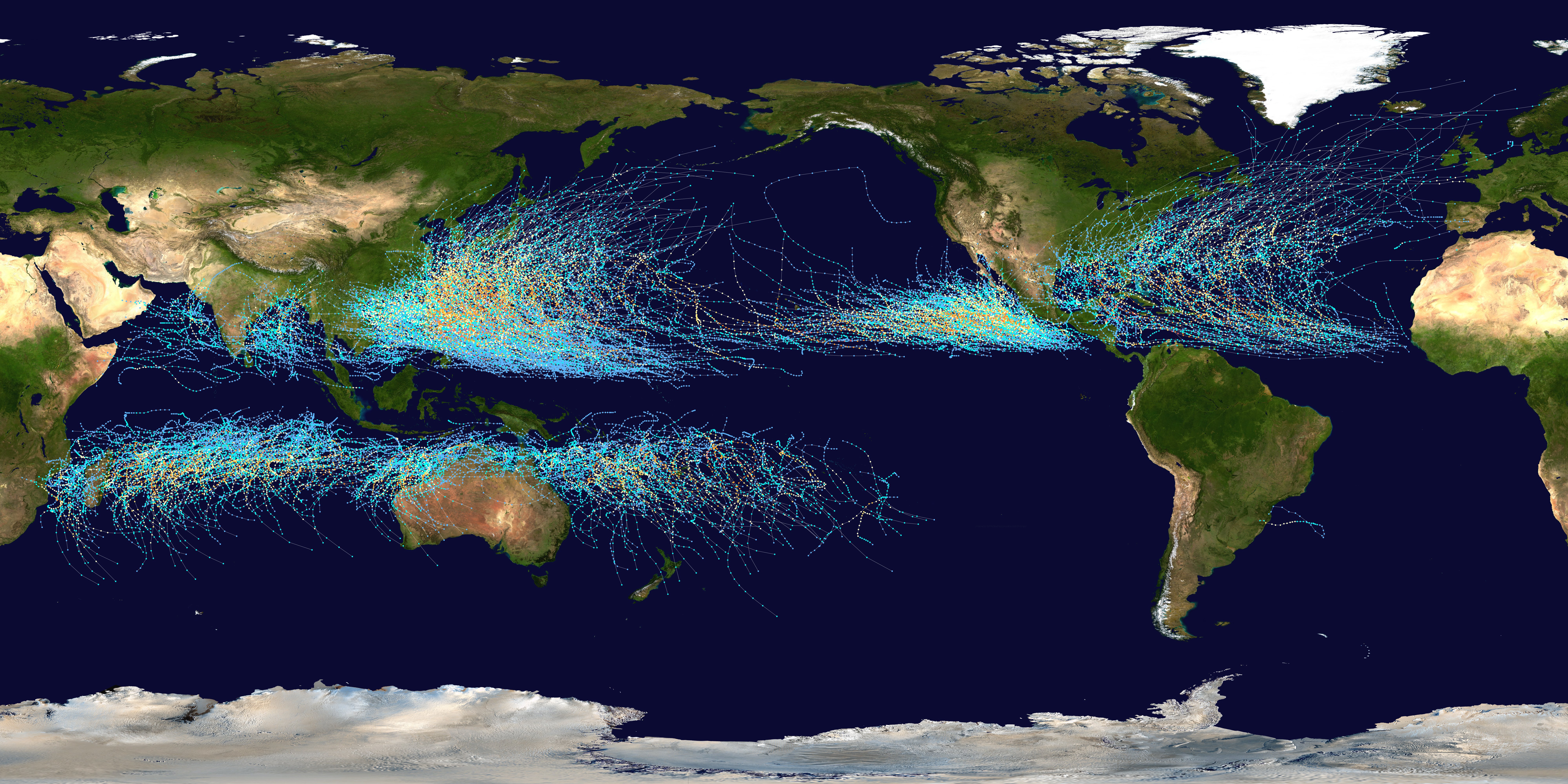
Hurricane tracks

A beautiful image of the global storm tracks of typhoons, worldwide, 1980-2005:

Wednesday, August 22, 2007

The Vietnam/Iraq analogy and the historical profession

Bush operatives are announcing that the President plans to make a major foreign policy speech next week in which he will, like Giuliani in last month's Foreign Affairs, claim that the lesson of the Vietnam War for today's war in Iraq is that we must stay the course:

"Here at home, some can argue our withdrawal from Vietnam carried no price to American credibility -- but the terrorists see things differently," Bush plans to tell a Veterans of Foreign Wars convention, according to speech excerpts released late Tuesday by the White House.

Bush will argue that the U.S. withdrawal from Vietnam had dire consequences for the people in that region and so would a withdrawal from Iraq.

"Three decades later, there is a legitimate debate about how we got into the Vietnam War and how we left," Bush will say. "Whatever your position in that debate, one unmistakable legacy of Vietnam is that the price of America's withdrawal was paid by millions of innocent citizens whose agonies would add to our vocabulary new terms like 'boat people,' 're-education camps,' and 'killing fields.'"

Where does Bush get this stuff from, you might well ask. Certainly, the vast majority of mainstream professional historians scoff at these views of Vietnam. The LA Times article, for example, cites Bob Dallek's sputtering reaction:

Historian Robert Dallek, who has written about the comparisons of Iraq to Vietnam, accused Bush of twisting history. "It just boggles my mind, the distortions I feel are perpetrated here by the president," he said in a telephone interview.

"We were in Vietnam for 10 years. We dropped more bombs on Vietnam than we did in all of World War II in every theater. We lost 58,700 American lives, the second-greatest loss of lives in a foreign conflict. And we couldn't work our will," he said.

"What is Bush suggesting? That we didn't fight hard enough, stay long enough? That's nonsense. It's a distortion," he continued.

Dallek of course is right that what Bush is saying is arrant historical nonsense, motivated by a desire to lay political blame for the disaster on his opponents. Dallek is also right that "the disaster is the consequence of going in, not getting out." But I am afraid that these points are largely irrelevant.

What's critical here is that Bush is drawing his history not from the professional historians, but from an alternative, parallel universe of historical knowledge. Specifically, the two works that lie in the background to Bush's "lessons of Vietnam" are A Better War: The Unexamined Victories and Final Tragedy of America's Last Years in Vietnam by Lewis Sorley, whose job is as a Member of Board of Governors at the Reagan Ranch; and Triumph Forsaken: The Vietnam War, 1954-1965 by Mark Moyar, who currently serves as an adjunct instructor at the Marine Corps college in Quantico, having been unable to secure regular academic appointment.

The epistemic community of professional academic historians tends to dismiss the knowledges expressed in these works with words like "amateur," "unrigorous," "journalistic," "hack" and so on. In fact, what Dallek's fulminating animadversions suggest is that the scholarly community does not really understand that works such as these are best understood as (asymmetric) competitors for the hearts and minds of the American public. Dalek's comments reminded me of the helpless hand-wringing at the dinner I attended at the Society for History of American Foreign Relations (SHAFR) last year. "How could we [professional diplomatic historians] have let the Iraq war happen?" one historian asked, in all seriousness. Embedded in her rhetorical question was the assumption that it was the historians assembled in that hall that were the actual arbiters of the nation's understanding of its own historical past. What she misunderstood (or perhaps did not know) was that she and her professional peers are neither the only nor (arguably) the most influential producers of knowledge about this nation's past.

To dismiss writers like Sorley and Moyar as producers of somehow sub-legitimate forms of knowledge is thus to miss the point. In fact, they are members of an alternative history movement, one which produces knowledge that is at least as impactful on popular and policy-maker conceptions of the past as anything produced in the academy. This alternative history industry occupies a similar epistemic place relative to professional historians that the holistic medicine movement does to the doctors in the AMA: we professional historians may view the ideas expressed in these books as crackpot quackery, but this professional opinion doesn't stop millions of people from rejecting the professionals' diagnoses, and instead adopting the quacks' recommendations.

What's more, these counter-historians understand, perhaps at a deeper level than most professional historians, that defining popular conceptions of key historical events is crucial for enabling current policy-making. (In this case, winning the political battle to stay in Iraq all but requires redefining in the American popular imagination what it means to fight an endless land war in Asia -- an image currently defined by the "quagmire" image of the Vietnam War.) The American Right realized in the 1980s that they had lost control of academic producers of historical knowledge. Academic historians were no longer producing historical knowledge that was usable by the Right. What the Right needed to do, therefore, was to set up a parallel knowledge production industry. While rehearsing the history of right-wing think tanks and their wingnut funders would take a long time, suffice it to say that the historical knowledge which fuels the political agenda of the American Right is today only rarely produced by academic historians. Instead, most of the historical knowledge circulating on the Right has been produced by knowledge entrepreneurs from outside the academy, working in think tanks, for opinion journals, and "independently."

This "historical knowledge industry" understands that the battle to dominate popular conceptions of key historical events does not take place by getting articles published in peer-reviewed journals, but rather by producing knowledge in formats and venues that reach wide popular audiences as well as the political-appointee community inside the Beltway. It likely pains professional historians to hear this, but the op-ed pages of the Washington Post and the Wall Street Journal (as well as relatively unwonky policy journals like Foreign Affairs and The Weekly Standard) are far more influential in defining popular understandings of key episodes in the nation's past than are the articles published in the American Historical Review, the Journal of Cold War Studies or Diplomatic History.

Denying Moyar a teaching spot at a research university may hurt his ego, but it scarcely limits his influence. Indeed, looking at Moyar's Amazon blog for Triumph Foresaken, what's striking is how the book has apparently received not a single positive review from a reputable academic journal, but has received raves from places like The Weekly Standard, New York Sun, The Wall Street Journal (op-ed pages), Marine Corps Gazette, ForeWord Magazine, the National Review, as well as from A-list conservative bloggers like Glenn Reynolds and Powerline. Moyar may by a Rodney Dangerfield in the academy, but he is also a far more effective public intellectual than practically anyone attending SHAFR.

At some point soon I'll try to find time to spell out in detail what all this means, institutionally and methodologically, for academic historians. But the basic point is simple. Professional historians need to wake up to the fact that the commanding historiographical heights are not to be found in our own professional academic journals, but rather are the op-ed pages of America's top newspapers, on talkshows, and in blogs. Maybe it's obvious, but it's worth saying explicitly: if you actually want to affect policy, you need to publish things that policy-makers will read.

Monday, August 20, 2007

Best. Movie. Line. Ever.

"The end of the world is nigh, the game is up":

The future will be like the past

Adam Gopnik, in the course of a business-as-usual-brilliant discussion of Philip K. Dick, has the following astute gloss on Dick's essential insight about the future:
The future will be like the past, in the sense that, no matter how amazing or technologically advanced a society becomes, the basic human rhythm of petty malevolence, sordid moneygrubbing, and official violence, illuminated by occasional bursts of loyalty or desire or tenderness, will go on.
The sense that the future will be like the past, and in particular that the "backward" parts of the world offer a more realistic vision of the future than the "advanced" parts, was the basic message we tried to communicate in our course this Spring on deviant globalization.

Friday, August 17, 2007

Iraq's destruction of all national sense of political proportion

Josh Marshall makes a great point about how the biggest strategic danger of the situation in Iraq is the way it is sucking all the oxygen out of discussions about all the myriad other global challenges facing the U.S.

What is not debatable however is that there is more going on in the world -- more opportunities and more threats -- than what happens in the few hundred mile radius around the ancient capital of Baghdad. There is, as we can see, Russia, which still has a few thousand nuclear warheads which could cause some serious headaches. There's China, a vast economic and potential military power that will bulk larger and larger in our lives over the course of this century. There's Pakistan, India, half a billion people to our south speaking Spanish and Portuguese. The list goes on and on....

In hotspots around the world, there's a vacuum, as the world sort of rushes past us. In many ways this is the greatest danger in Iraq, not that our future as a nation is at stake in staying (as the right would have it) or even that it's necessarily at stake in leaving but that our engagement with the country has fixed us with a dangerous national myopia which is letting many other problems fester unattended for going on a decade.

Josh could further have further pointed out that Iraq is distracting us not just from other overt political challenges, but also from the dangers associated with massive global financial imbalances, and from emerging threats ranging from climate change to engineered biohazards. The measure of Iraq's deformation of the national dialog is not so much that the GOP candidates are falling over themselves to see who can make the most blood-curdling cry for escalation, but rather that none of the leading candidates in either party seem to have much of any foreign policy beyond some position on the so-called GWOT. It's sad, really, how much the sense of policy and political proportion has dribbled away, like a dry wadi, into the Mesopotamian sands.

Thursday, August 16, 2007

Picture of the day

Saõ Paulo: an apartment building for the wealthy overlooks a favela, ironically called Paraisópolis (Paradise city):
Photo credit: Luiz Arthur Leirão Vieira (Tuca Vieira). Hat tip: JB.

And here's the view of that same building, from the favela:

And here's the same neighborhood from afar:

Best movie line ever: "Napalm in the morning"

Andrew Sullivan does it, so I think I will too: my favorite movie lines ever.

Here's as good a place to start as any:

Wednesday, August 15, 2007

Statistic of the day

Tagging:
Los Angeles cleanup crews removed 27 million square feet of graffiti last year, up from 21 million square feet in 2005, officials said. In other areas of Los Angeles County, 13 million square feet of walls and other surfaces were cleaned, 4 million more than in the previous year, county public works records show.

Learning the wrong historical lessons: Giuliani edition

In his ghost-written piece for Foreign Affairs, Rudy Giuliani compares the situation in Iraq today to that in Vietnam in the early 1970s and draws the following historical lesson:
America must remember one of the lessons of the Vietnam War. Then, as now, we fought a war with the wrong strategy for several years. And then, as now, we corrected course and began to show real progress. Many historians today believe that by about 1972 we and our South Vietnamese partners had succeeded in defeating the Vietcong insurgency and in setting South Vietnam on a path to political self-sufficiency. But America then withdrew its support, allowing the communist North to conquer the South. The consequences were dire, and not only in Vietnam: numerous deaths in places such as the killing fields of Cambodia, a newly energized and expansionist Soviet Union, and a weaker America. The consequences of abandoning Iraq would be worse.
Let's take this apart sentence by sentence. I suppose few people would argue with the assertion that we fought the first years of the Vietnam War with the wrong strategy. The notion that we showed "real progress" in the early 1970s, however, is transparent nonsense. While the death rate for Americans dropped, the political legitimacy of the South Vietnamese government never came anywhere close to stability, and the carnage in the Vietnamese countryside only grew worse. Second, the North Vietnamese ability to impose political terms on Thieu in the South were only becoming more effective. Indeed, they had extracted a concession from the United States that denied South Vietnam's separate sovereignty from the North. When Thieu refused to accept this, Nixon felt compelled to commence the Christmas Bombing of North Vietnam. Rudy's ghostwriters may feel they can assert that by the early 1970s we had succeeded in defeating the North Vietnamese, but without getting into the details, suffice to say that engaging in a massive escalation in Year 7 of a war is an odd choice for a military that feels it has already won. Third, while it's true that American withdrawal of funding accelerated the collapse of the Thieu regime, the conquest of the South by the ARNV would not have happened so quickly if Thieu's regime was not politically collapsed to begin with. Fourth, the implied idea that if only we had stayed things would have turned out better for the United States ignores that dire moral impact that the heedless killing of millions of Asian peasants was having on American political culture, not to mention the fact that the price of the war was bankrupting the country. Fifth, the idea that the Soviet Union was "energized" by the U.S. defeat in Vietnam ignores already well down the path toward economic implosion that would eventually do it in, and shows the way in which the neocon right still doesn't understand that it was containment, not rollback, that won the Cold War. Sixth, the suggestion that "the killing fields of Cambodia" was part of the aftermath of our withdrawal from Vietnam carefully elides the fact that it the U.S. supported Pol Pot and the Khmer Rouge, who were responsible for those killing fields, whereas it was the Vietnamese Communists who opposed and eventually ousted Pol Pot. Finally, the notion that the consequences of leaving Iraq would be worse than those we faced after leaving Vietnam is (in addition to being bare, unsupported assertion) predicated on the (frankly, criminally insane) assumption that (a) things would have been better if we had stayed in Vietnam past 1973, and (b) that things turned out so bad for us. Wait guys, didn't we win the Cold War after we left Vietnam? Just checking.

I don't normally agree with Greg Djerejian on foreign policy, but his summation of Rudy's position as "Walt Rostow meets the Sopranos" is just right.

Monday, August 13, 2007

The complexity of modern life

A very cool Japanese video that does an amazing job (to the sound of Norwegian electronica) of capturing the insane complexity that subtends that banal everydayness of modern urban life.

Hat tip: AH.

Monday, August 06, 2007

Statistic of the day

From a review of Alan Weisman's The World Without Us:
There is six times more plastic by weight on the sea's surface than there is plankton.
As my grandmother used to say, "Ca va mal finir."

Friday, August 03, 2007

The left then and now

Hedrick Hertzberg, attending YearlyKos, makes the following acute observation about this generation's antiwar crowd versus the one that protested Vietnam:
I think the difference between today’s left and yesterday’s is partly explained by the difference between the wars that have energized them. Vietnam was, as Bob Dole might say, a “Democrat war.” You couldn’t protest it just by putting your energies into electing Democrats, and of course you couldn’t do it by trying to elect Republicans, who liked the war even more. You had to go to the left of the Dems, and if you hadn’t happened to have already acquired a moral/political compass, you might keep going till you ended up at the feet of Chairman Mao. This war is an all-Republican affair. And this generation, thank God, is perfectly content to stick with Chairman Howard.
The Republicans are trying desperately to turn assign the blame for the Iraq catastrophe more widely (or, ideally, to pin the blame entirely on the "Defeaticrats") but this war is transparently Mr. Bush's war that the effort is almost certainly bound to fail. Indeed the effort to do so seems increasingly farcical, in the "18th Brumaire" sense of the word.

19 million South Asian climate refugees -- THIS YEAR


The AP describes the impact of this year's freakishly heavy South Asian monsoon:
At least 186 people have been killed and 19 million driven from their homes as heavy monsoon rains triggered floods, destroyed crops and submerged roads across a wide swath of northern India and Bangladesh.
William Gibson famously observed in 1999 that, "The future is already here. It's just not very evenly distributed." Most people have taken that statement to be an optimistic reference to the diffusion of high technology. But the same insight applies in a negative way to the arrival of climate change impacts.

Thursday, August 02, 2007

Climate of Fear: Bangladesh and India

This article on the impact of climate change in Bangladesh is six months old, but does a nice job of showing how its is the multiple systemic failures in Bangladesh that make it particularly vulnerable to climate change:

Every year these waterways burst their banks as rainwater and ice melt sluice down from the Himalayas towards the Bay of Bengal.

Cyclones and tornadoes pummel the coast annually, bringing further misery to a country slightly larger than England, yet crammed with 145 million people. Local sea levels appear to be rising, and summer temperatures climbing, causing droughts in the north west.

The result is a "perfect storm" of environmental factors that could make Bangladesh the first significant country to be destroyed by climate change. "Bangladesh is in such a difficult position because all these factors — geographical, demographic, political and climatic — have conspired together," said Atiq Rahman, head of the Bangladesh Centre for Advanced Studies and an IPCC member. "It is a test case for the rest of the world."

He predicts that if the sea rises by a metre — as some scientists say it will by 2100 — a quarter of Bangladesh will be submerged, forcing 30 to 40 million people from their homes.

As floods have pushed sea- water far inland, contaminating paddy fields and water supplies, thousands of farmers, like Mr Gain, have turned their paddy fields into shrimp farms. They earn more cash, but are less well-off because they no longer have their own food supplies. That leads to malnutrition and disease.

The obvious horror in all this is the looming humanitarian catastrophe. But from an analytical perspective, the really frightening question is: where will all those refugees go? Some will flood into the overcrowded Bangladeshi cities of the North, but many are likely to go (or attempt to go) to India, a country itself acutely vulnerable to climate-related crises. In other words, even aside from the direct impact of climate change on India itself, the impact of climate change on its neighbors is likely to cripple India's growth and stability.

Friday, July 27, 2007

These people are psychotic

The Heritage Foundation just produced a scenario for what will happen if we start bombing Iran -- what they call "a focused but restrained use of mili­tary power."

Short answer: No worries! Good times for all!

Not only will be economic consequences be much less than the doomsayers predict, but the new war will actually have the collateral advantage of providing a policy opening for measures that the pinks and liberals have for so long stymied, such as permitting oil drilling in ANWR and the Gulf waters, and rolling back of energy conservation measures (higher CAFE standards) and environmental regulations (the Clean Air Act). Actually, the thing I found most surprising about the scenario was that these guys didn't seem to realize that another obvious consequence of bombing Iraq is that it will require an abolition of the capital gains tax to tide us through the emergency.

Hat tip: TC.

Thursday, July 26, 2007

Climate-change induced conflict

An additional source of conflict that climate change may induce is to open up competition over jurisdictionally ambiguous spaces that previously were so inaccessible as to not really be worth disputing. The Russians are aggressively asserting their claims to vast stretches of the Arctic, not for strategic reasons (as during the Cold War), but because global warming has thinned the ice in the Artic to the point where exploiting hydrocarbons (control over which is the linchpin of contemporary Russian geostrategy) is now or likely soon will be possible. Next up: tearing up the 1959 Antarctica Treaty declaring that continent the sole province of science, so as to exploit the likely stupendous mineral resources of the continent.

Wednesday, July 25, 2007

Hannah Arendt's view of Evil

I've always been compelled by Arendt's view of evil as depiected in Eichmann in Jerusalem. Here's Amos Alon's excellent gloss on Arendt's view of evil:
In The Origins of Totalitarianism, she still held on to a Kantian notion of radical evil, the evil that, under the Nazis, corrupted the basis of moral law, exploded legal categories, and defied human judgment. In Eichmann in Jerusalem, and in the bitter controversies about it that followed, she insisted that only good had any depth. Good can be radical; evil can never be radical, it can only be extreme, for it possesses neither depth nor any demonic dimension, yet--and this is the horror!--it can spread like a fungus over the surface of the earth and lay waste the entire world. Evil comes from a failure to think. It defies thought, for as soon as thought tries to engage itself with evil and examine the premises and principles from which it originates, it is frustrated because it finds nothing there. That is the banality of evil.
I agree entirely: evil comes from a failure to think.

Tuesday, July 24, 2007

Trendhunter: Moustachio vendettas

A truly bizarre story about the "Moustache War of Upper Egypt," but perhaps a leading indicator for something profound, namely the ever-increasing importance of cultural symbolism:
Moustache war shakes southern Egypt


When an elder was kidnapped in a clan dispute in conservative southern Egypt, the al-Arab family's worst fears were soon realised -- they received a package containing his moustache, local media reported on Sunday.

The man himself was returned uninjured, but the use of the new shaving tactic sent shockwaves through the town of Mahrusa, near Luxor, 650km south of Cairo, where a man's honour is measured by the size of his moustache, the al-Gomhuria daily said.

The conflict that started with a coffee-shop brawl swiftly spiralled out of control, with the al-Arab carrying out a humiliating reprisal shave on a leading member of the Fallaheen family, followed by all-out battles with sticks and clubs.

Police and community leaders then intervened, restoring a relative calm to the town, the paper said, with those worst hit by the conflict set to remain indoors for the coming weeks pending the regrowth of their manliness.

I suspect this story awaits its Robert Darnton.

Climate change sparked historical wars in China

I'm not usually convinced by arguments that rely on data-mining historical patterns, since much of historical is contingent and dependent on human agency, but this argument about climate change triggering regional wars in China is striking nonetheless:

Cool periods in China, and the resulting scarcity of resources, are closely linked with a higher frequency of wars over the past 1000 years, according to Chinese researchers.

The research, which compared variations in climate with data from 899 wars in eastern China between 1000 and 1911, was published earlier this month (9 July) in the journal Human Ecology.

The finding that resource scarcity and shrinking agricultural output caused by changes in temperature is a major driver for war also applies to current society, says David Zhang, lead author from the Department of Geography at the University of Hong Kong.

Although Zhang did not analyse any warming periods, he believes extreme climate events ― both cold and hot ― could have a disastrous effect on the earth's ecosystem.

"It is more apparent that colder temperature would cause less crop production. However the ecosystem and agricultural production, once adapted to lower temperature, would surely be disturbed in a higher temperature today," he said.

Zhang believes that changes in ecosystems could lead to social, economic and political change, and could spark off wars. Historically, warfare has been a way of redistributing resources in response to climate change.

Wang Shaowu, from Peking University's Department of Atmospheric Physics, agreed that climate changes played an important role in the switch of dynasties and social revolutions in Chinese history.

He noted that drought and less precipitation, which do not always coincide with cold periods, were also significant factors affecting the agricultural production in countries like China.

According to Zhang, the finding also applies to ancient agricultural societies in other countries. For example, when the Ming dynasty (1368-1644) collapsed, other populated areas like Europe, Japan, Korea and the Ottoman Empire were also experiencing the most turbulent time in their history.

But according to An Chengbang, a research fellow with the Institute of Geography of Lanzhou University, both warming and cooling are long-term trends and the meteorological data collected during the past decades are not enough to accurately predict how global warming might influence agriculture.

Hat tip: MO.

Monday, July 23, 2007

What the impact of global warming looks like

No single storm or flood can be attributed directly to global warming. However, we can predict macro-level weather effects of global warming with great certainty -- hotter weather, more "extreme weather events," and so on. We can also known with a great deal of certainty which regions are generally unprepared to cope with such weather when it arrives. Densely populated, impoverished, badly governed, environmentally-degraded regions will suffer terrible human tolls. What will this look like concretely? Well, we're seeing the signs in Asia right now:

In China, floods have affected more than 8 million people in 43 cities across the southwest province of Sichuan.

Elsewhere in China, more than 200 people have died and 200,000 houses been destroyed.

Seven million people are short of clean drinking water, according to authorities.

In the Indian State of West Bengal, floods caused by monsoon rains have forced 700,000 people to be evacuated.

Thousands more have been marooned by rising water.

Again, we don't know whether these particular rains are being caused by global warming. But we can say with a high degree of confidence that as the impact of global warming accelerates, we're going to be seeing many more headlines like this, and worse.

Update: Britain also hit by worst flooding in sixty years.

Sunday, July 22, 2007

San Francisco, 1971

An amazing composite view of San Francisco, composed out of slides taken from the top of the Bay Bridge in 1971:

Click here on the image to see it in full size.

What an abomination that Embarcadero freeway was.

Friday, July 20, 2007

The very model of a modern libertarian

A brilliant reinterpratation of Gilbert and Sullivan's "Pirates of Penzance":
I Am the Very Model of a Modern Libertarian
by Kim Plofker

I am the very model of a modern Libertarian:
I teem with glowing notions for proposals millenarian,
I've nothing but contempt for ideologies collectivist
(My own ideas of social good tend more toward the Objectivist).
You see, I've just discovered, by my intellectual bravery,
That civic obligations are all tantamount to slavery;
And thus that ancient pastime, viz., complaining of taxation,
Assumes the glorious aspect of a war for liberation!

[Chorus:]
You really must admit it's a delightful revelation:
To bitch about your taxes is to fight for liberation!

I bolster up my claims with lucubrations rather risible
About the Founding Fathers and the market's hand invisible;
In fact, my slight acquaintance with the fountainhead Pierian
Makes me the very model of a modern Libertarian!

[Chorus:]
His very slight acquaintance with the fountainhead Pierian
Makes him the very model of a modern Libertarian!

All "public wealth" is robbery, we never will accede to it;
You have no rights in anything if you can't show your deed to it.
(But don't fear repossession by our Amerind minority:
Those treaties aren't valid---Uncle Sam had no authority!)
We realize whales and wolves and moose find wilderness quite vital,
And we'll give back their habitats---if they can prove their title.
But people like unspoiled lands (we too will say "hooray" for them),
So we have faith that someone else will freely choose to pay for them.

[Chorus:]
Yes, when the parks are auctioned it will be a lucky day for them---
We're confident that someone else will freely choose to pay for them!

We'll guard the health of nature by self-interest most astute:
Since pollution is destructive, no one ever will pollute.
Thus factories will safeguard our communities riparian---
I am the very model of a modern Libertarian!

[Chorus:]
Yes, factories will safeguard our communities riparian,
He is the very model of a modern Libertarian!

In short, when I can tell why individual consumers
Know best who should approve their drugs and who should treat their tumors;
Why civilized existence in its intricate confusion
Will be simple and straightforward, absent government intrusion;
Why markets cannot err within the system I've described,
Why poor folk won't be bullied and why rich folk won't be bribed,
And why all vast inequities of power and position
Will vanish when I wave my wand and utter "COMPETITION!"---

[Chorus:]
He's so much more exciting than a common politician,
Inequities will vanish when he hollers "Competition!"

---And why my lofty rhetoric and arguments meticulous
Inspire shouts of laughter and the hearty cry, "Ridiculous!",
And why my social theories all seem so pre-Sumerian---
I'll be the very model of a modern Libertarian!

[Chorus:]
His novel social theories all seem so pre-Sumerian---
He is the very model of a modern Libertarian!
Hat tip: NF.

The consequences of Iraq

Timothy Garton Ash summarizes the current conventional wisdom on the consequences of Bush's misadventure in Mesopotamia:
Besides the effective destruction of the Iraqi state, these include the revitalizing of militant Islamism and enhancement of the international appeal of the Al Qaeda brand; the eruption, for the first time in modern history, of internecine war between Sunni and Shiite, "a trend that reverberates in other states of mixed confessional composition"; the alienation of most sectors of Turkish politics from the West and the stimulation of authoritarian nationalism there; the strengthening of a nuclear-hungry Iran; and a new regional rivalry pitting the Islamic Republic of Iran and its allies, including Syria, Hezbollah and Hamas, against Saudi Arabia, Egypt and Jordan.
As we like to say around here: Mission Accomplished!

Thursday, July 19, 2007

Pessimism about the prospects for GHG abatement

Perhaps, as Bill Barnes suggested yesterday, I am too pessimistic about the prospects for the collective action necessary to mitigate climate risk. When I try to find reasons for optimism, however, I usually can only come up with one, and that is that we actually don't need to get that many global actors to agree on a framework for abatement. In fact, just three actors--the U.S., the E.U., and China-- account for about half of all global emissions. You add in Russia, India and Japan, and you have almost two thirds of global emissions. In other words, you only need to get three to six actors to agree to a framework.

Of course, the barriers to such an agreement are vast. China and India are fervent about achieving economic growth at almost any cost, and seem insistent that any abatement framework take into account historical emissions, not just current ones. Why should they be forced to abate emissions just as they are embarking on the road to wealth, when the U.S. and the EU were allowed to pollute their way to greatness? The Russians, on the other hand, seem to hold the daft notion that climate change (which they seem to think equals some nice linear "warming") will actually be good for them.

But the biggest problem is probably here in the United States. Our people are so greedily materialistic, and our leaders so fecklessly beholden to the pettily venal interests of consumerism (both supply- and demand-side), that it seems hard to imagine how the U.S. will embrace any serious abatement program. Which politician is going to have the temerity to tell the American people they must live in smaller homes, drive smaller cars, live in more compact cities, and pay much higher prices for electricity? Can you imagine anyone getting elected on that basis? Just remember back a few years ago to this famous moment:
Not long ago, the Democratic-led Senate took up the issue of stricter fuel-efficiency standards, only to reject the idea. At one moment during the debate, the Senate Minority Leader, Trent Lott, exhibited a picture of a Smart car as if he were a lawyer prosecuting a multiple homicide. Pointing to the ultra-efficient and—necessarily—small automobile, which is popular in cities like Paris and Rome, he suggested that it would be an offense for anyone in the United States to consider driving one. "This is still America," he declared.
It is only with peril that one can dismiss such incidents as mere buffoonery.

Ken Arrow on climate change

1972 Nobel Economist Ken Arrow, whom I met recently at a talk by Tad Homer-Dixon at Stanford, explains why climate change is the quintessential global public good (bad):
Two factors deserve emphasis, factors that differentiate global climate change from other environmental problems. First, emissions of CO2 and other trace gases are almost irreversible; more precisely, their residence time in the atmosphere is measured in centuries. Most environmental insults are mitigated promptly or in fairly short order when the source is cleaned up, as with water pollution, acid rain, or sulfur dioxide emissions. Here, reducing emissions today is very valuable to humanity in the distant future. Second, the scale of the externality is truly global; greenhouse gases travel around the world in a few days. This means that the nation-state and its subsidiaries, the typical loci for internalization of externalities, are limited in their remedial ability. (To be sure, there are other transboundary environmental externalities, as with water pollution in the Rhine Valley or acid rain, but none nearly so far-flung as climate change.) However, since the United States contributes about 25% of the world’s CO2 emissions, its own policy could make a large difference.
In sum: the U.S. can and should act unilaterally on abating GHGs, but global collective action is also necessary.

Schelling on climate uncertainty

Thomas Schelling, the 1995 Nobel Economist, puts a fine point on the argument that the inarguably vast uncertainties with regard to climate change are a justification for inaction in terms of GHG abatement or adaptation and preparedness measures:
In some public discourse, and in sentiments emanating from the Bush Administration, it appears to be accepted that uncertainty regarding global warming is a legitimate basis for postponement of any action until more is known. The action to be postponed is usually identified as “costly.” (Little attention is paid to actions that have been identified as of little or no serious cost.) It is interesting that this idea that costly actions are unwarranted if the dangers are uncertain is almost unique to climate. In other areas of policy, such as terrorism, nuclear proliferation, inflation, or vaccination, some “insurance” principle seems to prevail: if there is a sufficient likelihood of sufficient damage we take some measured anticipatory action.

Tuesday, July 17, 2007

Sisley advert

Annals of "you can't make this shit up": check out this new ad for Sisley that a Shanghai advertising agency just put out:


I particularly like three details in this ad. First, look at the eyes of the model on the right: she appears seriously wasted -- like it's about 6:30 am after a long, long night. Good times. Second, look at the credit card near the bottom of the image: what's neat is that it seems to have some kind of real powder on it ("china white"?) -- an excellent application of co-branding that I am sure the Chase execs in New York will really appreciate. Third, look at the text, which describes these models as "fashioin junkies." At first I thought this was a mispelling, but I think it's actually a pun, a play on the spelling of "heroin," but also a tongue-in-cheek nod to the way Chinese translations of English magazine ad copy typically mangle spelling and grammar.

Monday, July 16, 2007

Impact of climate change: a scenario

James Galbraith:
The climate collapse—which may bring the flooding of New York, Boston, London, Calcutta, and Shanghai—will be a calamity next to which the end of the Soviet Union will seem very small. Long industrial chains, for jet aircraft, automobiles, telecommunications, electricity, and much else, will crumble, as they did in the USSR and Yugoslavia, particularly if new interior boundaries form and countries break up. And interior boundaries will form, as those on the high ground seek to defend it. The demographic effects will be similarly dire: Older, urban males (like me) with no survival skills will die. Rural New England will turn into a deforested exurban slum.

This brings us back to... public policy. The function of the government, in principle, is to foresee these dangers, and avert them. The powers of the government exist to permit the mobilization of resources required. And only government can hope to do the job.

This is bleak news not only in the present climate of thought, but also given the decay of the public sphere since at least 1981. Whatever government might have been (or seemed) capable of in the 1940s or the 1960s, it plainly is not capable of today. A government that cannot establish a functioning Homeland Security Department in half a decade, a government that is capable of creating the Coalition Provisional Authority or Bush’s FEMA, is no one’s idea of an effective instrument for climate planning. Plainly the destruction of government—the turning over of regulation to predators, military functions to mercenaries, the Justice Department to a vote-suppression racket, and the Supreme Court to fanatics—has been the price of tolerating the Bush coup of November 2000. Soon we will face the aftermath of all this, with the fate of the earth in the balance.

Therefore: government will have to be rebuilt. The competencies necessary will have to be learned. The necessary powers will have to be legislated. Safeguards—against corruption, against abuse, against predation, against regulatory capture—will have to be designed. The corporate consumer culture will have to be brought to heel, and the long food production chains [will] have to be shortened. At the same time, a new project of physical, technological, and urban social engineering will have to get under way.

The reason why the ideological right is absolutely terrified of the climate change issue is that it inevitably raises the necessity of radical government activism and intervention (and redistribution). The causes of global warming are so deeply systemic that only a radical governmentality can possibly hope to abate it. The other prospect is civilizational collapse, somewhere probably long about the middle of the next century.

Personally, I find the latter scenario most likely, that is, civilizational collapse. I believe that the global middle classes stand ready to make literal Louis XIV's famous dictum, après moi le déluge, rather than give up their blighted eidolon of endless growth. Only a global benevolent dictatorship of some sort could derail the ambitions of that global middle class and its political enablers. But the Catch-22 is that any global dictatorship is highly unlikely to be benevolent.

In short, we're fucked.

Sunday, July 15, 2007

Where does wealthy come from

Very interesting New York Times article about the new class of super-wealthy, and the debate over whether they really "deserve" all that money. This is how one of those guys justifies his huge wealth accrual:

Other very wealthy men in the new Gilded Age talk of themselves as having a flair for business not unlike Derek Jeter's "unique talent" for baseball, as Leo J. Hindery Jr. put it. "I think there are people, including myself at certain times in my career," Mr. Hindery said, "who because of their uniqueness warrant whatever the market will bear."

He counts himself as a talented entrepreneur, having assembled from scratch a cable television sports network, the YES Network, that he sold in 1999 for $200 million. "Jeter makes an unbelievable amount of money," said Mr. Hindery, who now manages a private equity fund, "but you look at him and you say, 'Wow, I cannot find another ballplayer with that same set of skills.'"

At an intellectual level, what I find most outrageous about the superwealthy is not that they think they "deserve" to earn insane multiples more than mere mortals, or even that they think of themselves as a force for good in the world (which some of them may be). No, what's most appalling is the way they think their wealth is entirely due to their own talent, and that it has nothing to do with the public providing a structuring environment in which such wealth is achievable. They have no awareness, in other words, that "the market" is a construct that depends, hugely, on norms and services that are collective -- and that arguably should be paid for by those who benefit most from them.

The Derek Jeter parallel is astounding mainly not because some tycoon has the temerity to compare himself to Jeter -- who, incidentally, gets his $20m+ a year despite being the second-worst fielding shortstop in the bigs. What's most amazing is that Hindery seems to have no inkling that Derek Jeter's getting paid millions for hitting a leather ball with a stick is not simply a result of "innate talent," bur rather has something to do with the structure of the sports market. If anything, such sports metaphors ought to give these latter-day robber barons pause. Consider this simple mental test: is the reason why the top baseball players today get paid 30x what they did in the 1950s or 1920s because they are 30x more talented than their predecessors? Or might it have something more to do with the way the market for major league sports has changed over the intervening years? And who shapes that market?

Sometimes I wonder whether assholes like Hindery say stuff like this to the New York Times as of some Grover Norquist-orchestrated PR effort to keep the top marginal tax rates down. (Can these people really believe in the hearts believe that markets are "natural" and not man-made? Have they really no appreciation for the enormous element of luck that plays into business success -- much, much more so than success in professional sports?) But then I remind myself what people I've met like this are like, and I realize that they really are that arrogant and that ignorant.

And let's not even get into the way in which the existence of a class of superwealthy people fundamentally undermines the operation of a democracy that has evolved a de facto pay-to-play model of representation.

Tuesday, July 10, 2007

The Facebook Platform

I don't usually write about tech stuff on this blog, but a friend's inquiry prompted me to write something about the new developer program over at Facebook. Facebook Platform is definitely an interesting innovation -- the exact opposite of the dithering that goes on at MySpace (which, incidentally, again reflects the social division between the two platforms that Boyd noted last month). And it's definitely being well-marketed: I note in particular that Bay Partners has started a whole fund just dedicated to funding Facebook apps. A funding vehicle solely dedicated to the ecosystem of what is itself only a startup? That's a marketing coup, for sure. It's also probably a waste of money (see last paragraph).

By far the most interesting part of the platform is the viral component - when a friend adds an app, their news stream notes it in their profile. Clicking on the item brings you to the app, where you can play with it yourself and/or add it. This is an extension of the general social networking aspect of the site. In Zuckerman's keynote launching the Platform, he brings up a political example: someone starts a group dedicated to a political point, and then he invites his friends; when they join, their friends are notified, and can then join themselves -- and the result is very useful especially for organizing flash mobs political rallies.

Now, this viral sharing of information obviously makes a lot of sense for organizing groups of people to do stuff. But the question is what kinds of applications do you want to share in this viral fashion. In other words, what kinds of apps will you want to add, just because you see your friends adding them? The obvious example that springs to my mind is games. If my friends think a game is cool, I'll probably try it. News alerts? Maybe (I might go, say, for an app that found the nastiest daily YouTube video). Personal finance stuff? Doubt it -- just because my brother adds a finance app doesn't make it seem that much more compelling to me.

But that's still thinking of apps in terms of single-user functions. The real killer apps in this space will surely be social apps, probably of sorts that we haven't necessarily thought of yet. The trivial example is a calendaring/invitation app -- if my friends start to migrate to a new calendaring app, I'll almost certainly go with them. The smart money is in thinking about what kinds of social apps might come next. Apps for doing stuff together. So what are quintessentially social activities that are currently underserved in the apps space? My initial thoughts (perhaps for obvious reasons, given why I am blogging at 5:00 a.m.): domestic matters. Apps related to babying and mommying? Cooking apps? (Anarchist cooking??) There could well be some very cool new ideas there.

Looking at the more macro story, this is an effort by Facebook to make the "Windows 95" play to developers. What I mean by that is that this is an entirely inward-looking application platform -- the stuff you build for Facebook will only work for Facebook users, and as a developer, you are at the mercy of Facebook at both a technical and a business level. How many crack developers will want to develop stuff for someone else's platform? It's only really worth it if the platform is/becomes the de facto standard for all users (e.g. Windows 95). Absent Facebook as a de facto standard destination for the majority of web users, however, there will always be bigger opportunities for developers in if they build apps outside Facebook. Which means that, unless they've thought of an app which is really tailored exclusively and exactly for Facebook users--e.g. extensions of Facebook's own core competencies--the best developers are likely to continue to develop stuff for the general Web, not for Facebook's proprietary platform.

It's all about the developers. As Steve Ballmer famously observed, "Developers, developers, developers, developers, developers, developers, developers, developers, developers, developers, developers, developers, developers, developers.... YES!"

Monday, July 09, 2007

QUOTE: Mike Davis on urbanization

Mike Davis:

This is not a war of civilizations but an oblique clash between the American imperium and the labor-power it has expelled from the formal world economy. The future contours of this new "twilight struggle" are difficult to foresee. Trends may persist or wholly original features, including unexpected ideological hybrids, may emerge.

Who, for example, would have predicted in 1900 the convergence just twenty-five years later between urban Marxism and rural rebellion in East Asia? The current vogue of Pentecostalism and Sayd Qutb in the new slums of Latin America, Africa, and Asia may be permanent hegemonies or, then again, the urban poor's version of the peasant millenarian movements and anticolonial Ghost Dances of the 1890s.

What is clear is that the contemporary megaslum poses unique problems of imperial order and social control that conventional geopolitics has barely begun to register. If the point of the war against terrorism is to pursue the enemy into his sociological and cultural labyrinth, then the poor peripheries of developing cities will be the permanent battlefields of the twenty-first century.

– "The Urbanization of Empire: Megacities and the Laws of Chaos," Social Text 81 (2004): 14-15.

Who will take the blame for Iraq?

Reading the New York Times's day-late-dollar-short editorial calling for immediate withdrawal from Iraq brings to mind what I think is in fact the key question that is stalling all progress on the American Iraq policy: who is going to take the blame for the catastrophe? There strike me as being at least four different camps on this question, each of which has radically different political goals, and none of which are either willing to partner with another group or can form a majority on their own.

At one extreme are the die-hards. These guys still believe that the war was a great idea in the first place, and that it is capable of being brought to a successful conclusion. I'm thinking here of folks like the delightful Podhoretz family. These guys want to make sure that "if the venture fails" then the blame will go to anyone who at any time has expressed any qualms about motivations underlying the war--in other words, virtually all Democrats and a sizable number of Republicans.

These are the prime promulgators of the incipient Dolchstosslegende, blaming liberals and the media for the catastrophe, even as they deny that there is a catastrophe. These guys are trying a straight replay of the Vietnam blame game, trying to create the public impression that the reason we lost that war was because of media quislings and liberal pansies.

In this effort to blame the failure in Iraq on liberalism, however, these guys face two formidable challenges. First, unlike in Vietnam, it's awfully hard to rope the liberals into any responsibility for the way the war has been waged -- there's no LBJ or JFK to blame for starting the war. Second, the anti-war movement, such as it's been, has been far more polite (read: passive & ineffective) than its 1960s-70s antecedent. This time around, there just won't be rioting long-hairs for this wingnut fringe to pin the blame on. Cindy Sheehan's candlelight vigils just don't measure up to Chicago 1968.

With that said, these guys are definitely laying the groundwork for blaming the withdrawal on the next (almost inevitable Democratic) president. They're being assisted in this by Bush, who is doing everything he can to push off the withdrawal to the next administration, so that he can maintain for historical posterity that if only his course had been stayed, it would all have worked out great. And indeed, to some extent the political strategy is working: the threat of being blamed for the failure in Iraq is certainly part of what has the current Democratic leadership incapable of pushing hard for a withdrawal. You might say that they are scared of their party's historical shadow.

Second, at the other extreme, are those who want to blame the failure for the war in Iraq on anyone who supported the war in any way. This group blames a culture of imperialism, and wants to try to make anyone who supported the war look like an idiot, complicit in the catastrophe. The strategic goal for this group is to try to forge a historical sensibility that will hamstring this country's ability to commit similar crimes in the future. The maximal hope is to pin the blame for the war's failure on the political culture of imperialism--and thereby destroy that political culture. This prospect seems like a long-shot as well (cultures of imperialism do disappear, but it takes a greater trauma than the one we have thus far suffered in Iraq) but it explains the antics of folks like Cindy Sheehan.

What's interesting about this group is that while they call for immediate withdrawal, their efforts to affix the blame for the disaster on all who supported the war actually makes it politically more difficult to build a consensus to withdraw. In short , this group is willing to let the war go on longer rather than let those they deem co-responsible for the war get off scot free. They want the country to learn a lesson, not just make some hasty political compromises to get out of Iraq. Now, whatever you may think of the ethics of this position, it is clear that political decisions are never reached this way in this country. And I mean never: the whole political history of the country is a series of half-measures and compromises, and the idea that this is a turning point in that part of our political culture is foolish. Be that as it may, the fervently antiwar crowd, nonpragmatists to a man and woman, are trying to turn Iraq into the tombstone of American imperialism. Which is why committed American imperialists view these people as treasonous -- they intend to undermine what the imperialists consider to be the core values and ambitions of the country.

Third, you have the flip-floppers formerly known as liberal hawks (or, more accurately: the liberal imperialists) -- Hillary Clinton, John Kerry, pundits named Berman, etc. These guys supported the war, and believe in the empire, but realize that the Iraq war is lost and the time has come to leave, because staying only weakens the empire. This group mainly focuses its blame-gaming on the Bush administration, specifically on his execution of the war. In other words, these guys argue that the war was a good idea in the first place (which is why they voted for it), but that the implementation has been a hash. (In other words, if only a President Gore had been running the war, it would all have worked out great.) The main problem these guys face is that the argument is so out of kilter with the facts that it is hard to sell this story. Specifically, it's clear that there is an institutional, systemic problem that led us into this four year catastrophe, not just one man's poor leadership. However, this critique is all but impossible for them to make, because they suffer from the original sin of having voted for the Iraq War resolution in 2002. That original vote, supported by a little over half of the Democrats in Congress, is what makes it very difficult to blame the war on conservatism. The result is the ongoing flaccid finger-pointing at Bush, and little ability to get GOPers to support withdrawal. In sum, these people lack any political leverage on the issue, because they have so little credibility.

The last group, and really the key to all this, is the core of the GOP. Not the rightest half of the party that runs in uncontested GOP strongholds (they're in the first group), but rather the majority of the GOP politicians who face big political consequences if the voters decide to blame the GOP for the war. These guys have loyally supported Bush on the Ben Franklin principle that if they don't hang together, they shall most assuredly hang separately. But the Dems have also let these folks off easy so far, by not trying to pin the blame for the catastrophe on the GOP. The Dems have done this in large part, of course, because any attempt to blame the rank and file of the GOP for their support of the war runs into the tricky problem that many Democrats also supported the war, at least at first. These GOPers don't know who to blame for the war exactly, and most of them are politically terrified that no matter what happens, they are going to get blamed. On the one hand, since Bush will certainly get stuck with a huge chunk of the blame (unless some miracle lets him pull a chestnut of victory from the fires of Baghdad), sticking with Bush is presents a horrible political risk. On the other hand, breaking with Bush to go with the liberal hawks presents the same problems for this group as it does with the liberal hawks: how can you blame Bush alone for something that you supported so vociferously for so long? None of these people want to be the first to break with Bush, but none of them want to be left behind with the wingnut fringe, if they're in a swing district and a lot of the party has already moved.

In sum, it's a classic political impasse. But here's the key point: this impasse is a disaster for the troops on the ground. While Washington plays a four-way game of political chicken over the political responsibility for the policy failure, its the military that continue to ooze blood into the sands of Mesopotamia. Rather, what the troops want (need!) is a reasonable, realistic discussion of what comes next. The original mission--to create a stable, democratic, prosperous Iraq that would be a beacon of hope and change for the Middle East--clearly has failed. Dead as a doorknob, and everyone knows it. So, given that Iraq is in a civil war, the question is: what next? Specifically: what do we want our force posture in the Middle East to be in five years, and how do we get there from here in an orderly fashion?

That's the debate the military wants us to have, but in the meanwhile, Washington is trying to sort out who is going to take the fall for getting us into the mess. And whatever the rhetoric on all sides, that's hardly supportive of the troops.