Michael Signer's essay is yet another in an all-too-numerous list of recent works by center-left intellectuals arguing that America can recover from its present international difficulties by changing the style of its approach to the world without significantly changing its policies. He denounces the "vulgar exceptionalism" of the neoconservatives and the Bush Administration but does not realize that we are well past the days when a tonier, more agreeably phrased American exceptionalism could command real support from most of the rest of the world. Signer's argument reflects the fact that, in the end, by far the greater part of the Republican and Democratic establishments share the same basic myths of American nationalism concerning the righteousness of American power, the same commitment to U.S. supremacy in the world, and a common adherence to the same set of basic imperial strategies. And until progressive foreign policy thinkers confront these myths, they only will offer up alternative slogans or tactics but nothing resembling a foreign policy vision.
Take Signer's supposed alternative to the failed policies of the Bush Administration, "exemplarism." He writes, "[In today's globalized environment], it is simply impossible for any country, even one as powerful as the United States, to ignore or neglect its interconnections with other nations." At the same time, Signer is a strong believer both in America’s superpower status and in innate American virtue: What he calls "the ineluctable attractions of [America's] own unique capabilities and goodwill–by the charisma of its own great character...."
Signer does not seem to appreciate that, like any other country... America is judged by others not just on its present actions and declarations, but on its past record. If, as he himself says, the recent record of the United States has been so awful, why should other countries automatically trust America in the future? Like so much of the U.S. foreign policy establishment, Signer fails in what Hans Morgenthau laid down as one of the most fundamental virtues of true statesmen: The ability to put themselves in the shoes of other countries.
Signer declares that "exemplarism would value both strength and international prestige equally, seeing them not as mutually exclusive but rather as mutually reinforcing" and that "America's economic, political, and military strength, when deployed wisely, enhances our prestige around the world." Who could possibly disagree? But, once again, what does "deploying American strength wisely" actually mean in practice? And who gets to decide what is "wise"? Is it America alone, or do American allies get a real say when it comes to designing and changing American policies? Without a real willingness to change American policies, it may be possible to bring about the kind of sullen acquiescence to the United States that one sees at present in Western Europe, for example, but it will be quite impossible to get nations outside that sphere to make real sacrifices for the sake of those policies and thereby lighten the present unsustainable burden on American resources. It is easy to talk of a need for more diplomatic approaches by the United States, and it is true that leading members of the Bush Administration have been notoriously and dangerously contemptuous of the very idea of diplomacy. But the liberal hawks who praise diplomacy in principle also appear to misunderstand its true nature. When they speak of engaging other countries diplomatically, what they usually mean is talking at them more loudly and sweetly, but with the same ends in mind. True, this has always been a key feature of diplomacy. But real diplomacy also means a recognition of other states' vital interests and a willingness to reach compromises accordingly. This, by contrast, is too often called–by Democrats as well as Republicans–"accommodation" or even "appeasement."
The weakness of Signer's approach is exemplified by his treatment of the Iraq war. As with so many of his Democratic colleagues, he wriggles out of saying whether the war itself was a good or bad thing. Instead, he suggests that if only the Bush Administration had diplomatically enlisted European help, what happened in Iraq would have been very different. This is arrant nonsense. The Europeans were never going to be able to give serious help to the United States in Iraq. They have no effective military help to give, and their readiness to make financial sacrifices was always going to be severely limited by the–entirely correct–opinion of European policymakers and electorates that the whole U.S. strategy was fundamentally misguided.
Thursday, September 21, 2006
The "failure of execution" myth exposed


Wednesday, September 20, 2006
Cracking the code
Hezbollah guerrillas were able to hack into Israeli radio communications during last month's battles in south Lebanon, an intelligence breakthrough that helped them thwart Israeli tank assaults, according to Hezbollah and Lebanese officials.
Using technology most likely supplied by Iran, special Hezbollah teams monitored the constantly changing radio frequencies of Israeli troops on the ground. That gave guerrillas a picture of Israeli movements, casualty reports and supply routes. It also allowed Hezbollah anti-tank units to more effectively target advancing Israeli armor, according to the officials.
"We were able to monitor Israeli communications, and we used this information to adjust our planning," said a Hezbollah commander involved in the battles, speaking on the condition of anonymity. The official refused to detail how Hezbollah was able to intercept and decipher Israeli transmissions. He acknowledged that guerrillas were not able to hack into Israeli communications around the clock.
The Israeli military refused to comment on whether its radio communications were compromised, citing security concerns. But a former Israeli general, who spoke on the condition of anonymity, said Hezbollah's ability to secretly hack into military transmissions had "disastrous" consequences for the Israeli offensive.
"Israel's military leaders clearly underestimated the enemy and this is just one example," he said.
The Great Lie
If the case for war lacked a link between September 11 and Iraq, the Vice President would repeatedly cite the meeting that neither American nor Czech intelligence believed had taken place between Mohamed Atta and Iraqi intelligence in Prague: "It's been pretty well confirmed that [Atta] did go to Prague and he did meet with a senior official of the Iraqi intelligence service in Czechoslovakia last April, several months before the attacks," he would say on NBC in December 2001. "We discovered...the allegation that one of the lead hijackers, Mohamed Atta, had, in fact, met with Iraqi intelligence in Prague," he would say on NBC in March 2002. "We have reporting that places [Atta] in Prague with a senior Iraqi intelligence officer a few months before the attacks on the World Trade Center," he would say on NBC in September 2002. "The senator has got his facts wrong," he would then say while debating Senator John Edwards during the 2004 campaign. "I have not suggested there's a connection between Iraq and 9/11."
This was not a slip of memory in the heat of debate. This was dishonest, a repeated misrepresentation, in the interests of claiming power, so bald and so systematic that the only instinctive response (Did too!) was that of the schoolyard. By June 2004, before the debate with Edwards, Cheney had in fact begun edging away from the Prague story, not exactly disclaiming it but characterizing it as still unproven, as in, on a Cincinnati TV station, "That's true. We do not have proof that there was such a connection." It would be two years later, March 2006, before he found it prudent to issue a less equivocal, although still shifty, version. "We had one report early on from another intelligence service that suggested that the lead hijacker, Mohamed Atta, had met with Iraqi intelligence officials in Prague, Czechoslovakia," he told Tony Snow on Fox News. "And that reporting waxed and waned where the degree of confidence in it, and so forth, has been pretty well knocked down at this stage, that that meeting ever took place. So we've never made the case, or argued the case, that somehow [Saddam Hussein] was directly involved in 9/11. That evidence has never been forthcoming."
Tuesday, September 19, 2006
Sleepwalkers
I do not recognize my country today. It walks, it talks, but its eyes are glassy and vacant. I am not one of those who blames the Bush administration for this; our government is a symptom of our condition, not its cause. Several thousand people died in the attacks of September 11, but the changes in our political atmosphere that followed bear little understandable relation to the emotions of mourning, rage, revenge, or even fear. Objectively seen, those attacks did nothing to change the balance of power in the world, as an invasion or assassination might have. The bastards got lucky; that is all. But, like a trauma victim who suddenly sees his surrounding environment as alien and hostile, the United States reacted to those events by disengaging itself from reality, internationally and domestically. Mental disengagement combined with military engagement--a recipe for disaster....
[After] the planes struck, what happened next on the international scene is a matter of public record. What happened within the United States is less well understood abroad. To hostile foreign observers, the United States has simply reverted to type, revealing its true face as a brutal imperialist monster. From the outside, it looks like we are being driven by greed for oil, or hatred of Muslims, or blind loyalty to Israel, or contempt for the international community---we know the litany. From the inside, the last five years of U.S. history look very different. We are still a nation in shock--hardly capable of conceiving an imperial strategy, let alone pursuing it. That is why we still have no real strategy for dealing with the genuine threat of radical Islam, or for securing our cities and ports. When the decision to invade Iraq was being made, there were long, serious debates in the British House of Commons, which anyone with a satellite dish could watch on BBC. No such display could be found on U.S. television because no such debate took place in the U.S. Congress. The president was given carte blanche. And American reporters, like adolescents at play, donned military uniforms and joined the troops as "embedded" observers, gushing over the display of firepower. The nation slept.
While it slept, the clock of U.S. politics turned in reverse, back to the mindset of the cold war and the culture wars of the '60s and '70s. All sorts of strange types emerged from under their rocks to exploit September 11--neoconservatives longing for a war that would restore "American greatness" through militarism, legal anarchists who started rewriting the constitution, evangelicals who sensed the opportunity to launch a counter-revolution against all the cultural changes of the last four decades. None of these groups represented more than a fraction of Americans, but, together, they found the ear of a transformed president and of his political advisers, who knew how to exploit them in return. The level of American political debate sank to a new low and is now fixed on symbols--"values," "strength," "family," "security," "life," "freedom"--that bear little relation to contemporary American reality or the world situation. The '90s were a period of political maturation in United States, but, in the face of trauma, the nation has regressed to an infantile state. That includes Bush's many critics, who peddle Vietnam-tinged fantasies of a new antiwar movement and hope to revive adversarial press of the Watergate era. A reader of U.S. newspapers can be forgiven for thinking he is living in 1973.
This week will be taken up with commemorations of those who lost their lives on September 11, as it should be. But, when those ceremonies are over, we should also observe a moment of silence for the America that existed just before that September morning, and which now lies in a coma. We are destined to see that America again, if only because reality has a way of intruding into even the deepest sleep. But the wake-up will be hard. An entire nation will find itself on the floor, its knees bruised, its nose bloodied, the furniture in disarray, wondering just what the hell happened.
Monday, September 18, 2006
Liberal lies
In the case of Iraq, however, this meme supports the dangeous illusion that the problem with the war was one of execution, rather than ideology and aim. Alas, not even the most competent administrators in the world could have made the postwar in Iraq succeed. This is why the invasion was, to paraphrase Talleyrand, "worse than a crime; it was a blunder." While the White House may be filled with knaves, in the case of Iraq, the knaves were also fools.

Friday, September 15, 2006
Peanut butter
As Flavorpill’s film editor, Rosman contributes to all the city publications, and she has developed a feel for the subtle regional differences. "Chicago has its own kind of hard-core R.&B.-inspired scene and an art scene inspired by both theArt Institute of Chicago and cheaper rents. L.A. has a refracted neon palm tree glam, which is a reaction to all that Hollywood veneer that wends its way into visual art especially, but also into music and all the retro-movie houses. London, well those kids have a jaunty charm I've yet to pin down."
Thursday, September 14, 2006
How to rank Presidents
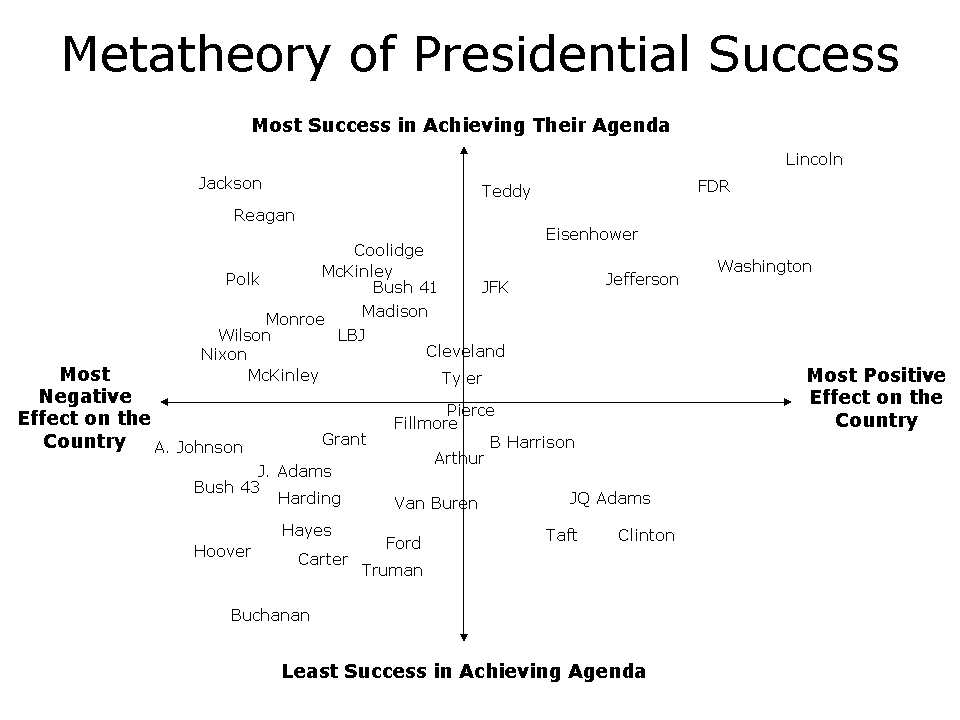
We've reached the point in George W. Bush's presidency where one can begin to think about where he will rank in the historical annals. The question of ranking Presidents is of course a vexed one, and an inherently political one -- how you weight his political versus his personal characters, his foreign versus his domestic policy, and so on, is by its nature subjective. My own effort to plot Presidential success is above, and I think the axes speak for themselves. The question is, how successful was the President on his own terms, versus the (alas, totally separate) issue of how much good or bad he did for the country.
The Washington Post today, has a slightly different take.
Wednesday, September 13, 2006
Iowa Futures Market on Midterms
- GOP retains control of both chambers: 44% chance
- GOP keeps Senate, Dems win House: 39% chance
- Dems win Senate, GOP keeps House: 5% chance
- Dems win both chambers: 12% chance
Tuesday, September 12, 2006
Squandering bipartisanship
Terrorists did not come and steal our newly-regained sense of being American first, and political, fiftieth. Nor did the Democrats. Nor did the media. Nor did the people.
The President -- and those around him -- did that.
They promised bi-partisanship, and then showed that to them, "bi-partisanship" meant that their party would rule and the rest would have to follow, or be branded, with ever-escalating hysteria, as morally or intellectually confused, as appeasers, as those who, in the Vice President's words yesterday, "validate the strategy of the terrorists."
Monday, September 11, 2006
Islamism in Sudan
The Sudanese version [of Islamism] was not a genuine revolution like the Iranian one; it was more of an elite project that never gained legitimacy outside of student, intellectual, and military circles. Still, Sudan's hard-line party, the National Islamic Front, marched the country through familiar paces. Suliman Baldo, the director of the Africa program at the International Crisis Group, who lived through the years of Islamization in Khartoum and published a report documenting the return of slavery in Sudan, said of the government, "They came with a social-engineering project--they were very open about this." Education became a form of indoctrination: small children learned jihadist chants; school uniforms were replaced with combat fatigues; students engaged in paramilitary drills and memorized the Koran; teachers overhauled the curriculum to focus on the glory of Arab and Islamic culture. Khartoum had been a socially relaxed city that celebrated Christmas, but now the morals police insured that women were veiled, especially in government offices and universities. The security agencies were taken over by Islamists, and torture chambers known as "ghost houses" proliferated in what had been a tolerant political culture.... And so an ethnically and religiously mixed African country, with an egalitarian form of Sufism as its dominant form of Islam, was mobilized by intellectuals and soldiers to create a militaristic, ideologically extreme state whose main achievements were civil war, slavery, famine, and mass death.Authoritarian High Modernism: Islamist Edition.
What's more, just substitute "Christian" for "Muslim" and "American" for "Arab" and you pretty much have the scenario the Christian Right dreams of for our own country.
Friday, September 08, 2006
"Mission Accomplished" Dept.: Talibanistan Edition
In a move that some say appears 'a total capitulation' to pro-Taliban forces, Pakistan signed a peace deal with tribal leaders in the North Waziristan region of Pakistan Tuesday, and is withdrawing military forces in exchange for promises that militant tribal groups there will not engage in terrorist activities.Read the whole thing. Lots of amazing links.
Wednesday, September 06, 2006
Cosmopolitanization
P. 108-9, 117; italics in the original; boldface mine.The thesis of this book may be summarized as follows: cosmopolitanization means the disappearance of the closed society for good. But this is not felt by liberation by most people, who instead see their world in decline. People who have succeeded with great difficulty in orienting themselves in the labyrinths of a closed society based on sharp oppositions between us and them, inside and outside, national and international, are now suddenly faced with the contradictions of a tolerant form of society and a liberty they can neither comprehend nor live wit, which reduces them to strangers in their own land....
Anti-cosmopolitanism, whether understated or vociferous, right- or left-wing, union- or church-driven, strictly speaking acts in an anti-national fashion because it is tantamount to a clinical loss of reality and hence betrays the interests of the nation in a global age. The economic, cultural and political challenges and contradictions of globalization cannot be conjured out of existence because we do not like reality and refuse to accept it -- on the motto 'Globalization? I'm against it!' The falling of leaves in autumn can't be prevented by looking the other way, and certainly not by insisting that you hate winter.
Tuesday, August 29, 2006
Progress in the Arts
Here's what this lovely couple looks like.One of the first pornographic images I ever saw was a spread of Dorothy getting gang-banged by the Tin Man, the Cowardly Lion, and the Scarecrow. It was crude smut, nothing more than titillation created for its shock value. And when my mother discovered it hidden under my bed, it was deposited in the trash. It wasn't a new idea. The Tijuana Bibles of the '30s and '40s were full of similar images: Betty Boop giving head; Lil' Abner sporting a healthy hard-on; Popeye impaling Olive Oyl on his spinach-strengthened member. In one of my favorites Donald Duck buggers Mickey as the Disney mouse squeals, "Tee-hee, Donald, that tickles so good." These eight-pagers were the lowest form of comics, anonymously created and distributed. The sub-genre continues to this day. Do an image search of Marge Simpson for examples. It's pornography at its most common: unoriginal and mindless.
The writer's Lost Girls (which will be published tomorrow) is a beautifully perverse graphic novel that elevates the pornographic tale; it is a bold, and rare, story of uninhibited sexual fantasy that succeeds at titillating as well as enlightening. It is sensually drawn by Melinda Gebbie, Moore’s wife.
As in The League of Extraordinary Gentlemen, Moore combines characters of the late 19th century and early 20th century for an epic adventure, except this time the adventures are sexual. The heroines from The Wizard of Oz, Alice in Wonderland, and Peter Pan meet as adults in an Austrian hotel in 1913, shortly before World War I. Dorothy, fresh off her Kansas farm, is a nympho in silver shoes; Alice is a world-weary lesbian; Wendy is a housewife trapped in a boring marriage. They romp with one another and tell their tales, sexually charged versions of the stories we associate with each character. In Wendy's case, Peter Pan is a male prostitute who seduces her and her brothers. Alice submits herself to the sexual dominance of the "Red Queen." Dorothy’s sexual awakening begins when she masturbates while caught up in a twister.
Moore explores a wide range of sexual fantasies. There are tales of pedophilia, bestiality, incest, rape, homosexuality, orgies, sadomasochism. In one of the many stories within the story, a Victorian family shares more than tea and crumpets, and the man of the house punishes his wife and two children by administering a rousing dose of anal sex. In defense of his lurid tale about the family (and of Lost Girls itself, one imagines), the hotel manager, declares, "They are fictions. They are uncontaminated by effect and consequence." It's a dirty book, no doubt; yet it still manages to paint an enchanting, fascinating world where the mind is free to roam.
The hotel manager later declares, "Pornographies are the enchanted parklands where the most secret and vulnerable of all our many selves can safely play." It’s a fitting description for Lost Girls, and only someone of Alan Moore's wild genius can pull it off. He wonderfully balances both ends of the smut/erotica spectrum, at times tipping toward the merely titillating, and then leaning toward that delightful world of exploration and discovery. Lost Girls is one of the most important works of pornography of our time and another example of the graphic novel as a powerful literary medium.

Monday, August 28, 2006
Post-Bushist foreign policy
If therefore both party establishments are wedded to the basic lines of the present US course, what are the chances of successful domestic revolt against this course? Since the present line is adhered to be the bipartisan establishment, it follows that any revolt against it would have to enjoy massive support from ordinary Americans, and in particular from the most important political constituency and political bellwether, the white middle classes of the "heartland." It would therefore have to appeal to the core traditions of this constituency. In this context, that means a mixture of intense nationalism with deep distrust of foreign entanglements – a mixture dubbed "isolationism" by the imperial elites, though by no means fairly.
The Left faces immense obstacles in appealing to the heartland. Its cosmopolitan traditions and above all its hostility to religion make it culturally very alien to the world of the suburbs and small towns of middle America. It is also wedded to its own version of liberal interventionism. If I have to listen to another American anti-Bush liberal damn the war in Iraq and then advocate US military intervention in Darfur I may eat my beard. This is both intellectual and electoral folly: intellectual, because there are no rational grounds for believing that a US military which has failed so badly in policing one bitterly-divided Muslim society would play a successful role in another. Electoral, because you cannot successfully appeal to ordinary Americans to reject a war for which at least some justification could be manufactured in terms of defending America, and then ask them to support another war for which there is no argument from national interest at all.
A much more hopeful prospect in the long run lies in a combination between the moderate realists and a populist revolt in the heartland against the costs of empire. Indeed, this would seem to me virtually inevitable sooner or later. As soon as it becomes clearly apparent to the White middle classes that a continuation of present levels of military spending and foreign policy activism requires the abolition of key middle class entitlements – social security, Medicare, mortgage relief and so on – mass pressure for a withdrawal from present levels of engagement will become overwhelming. This will happen all the sooner in the context of an economic recession, or if another war makes the reintroduction of conscription a real possibility.
Friday, August 25, 2006
Neocons then and now
The effects of the Central American war for the region were dreadful. In Nicaragua it left 30,000 dead (as historian William LeoGrande points out, relative to the population this was more than the United States lost in the Civil War, the two world wars, and the Korea and Vietnam wars combined). The country had over 100,000 refugees and an economy with inflation out of control and massive unemployment. In tiny El Salvador the effects were even worse; 70,000 dead, death squads roaming the countryside, villages destroyed, lives shattered. While the brutality of the El Salvadoran civil war surpassed anything seen in the recent history of Latin America, US efforts at imposing change -- with assistance costing around 1 billion dollars in military aifd and three times as much in economic aid -- had little effect: in 1990 more than 90 percent of El Salvadorans still lived in poverty.Funny how the neocons seem to get the same results wherever their policies get imposed. What's that old saw about doing the same thing over and over and expecting a different result? Westad continues with how this all went down at home:
Within the United States the wars also had serious effects, although not in terms of human lives. The Reagan administration's attempts at defying Congress in supplying funding to the Contras led to the Iran-Contra Affair, which hurt the neoconservative agenda with the public and inside the White House. The fact that Reagan's people had sold weapons to the Iranian Islamist regime and used the proceeds of that transaction to fund the counterrevolutionary forces in Nicaragua was a bit too much even for Reagan's supporters to swallow. Together with the antiwar movement and Congressional resistance against the war, the Iran-Contra Affair contributed to a distinct reduction in the administration's appetite for foreign internvetions toward the end of its final term in office. Its worldview, though, stayed intact: the Cold War was a conflict between good and evil, in which the United States was on the side of the angels.Pulverizing the countries they believe their are liberating, contempt for Congress and other quaint domestic political niceties, an unshakable faith in their own moral righteousness... eerie, isn't it?
Monday, August 21, 2006
"With Friends Like These" Dept.
These days, the mere opening of Mr. Bush's mouth makes many GOP loyalists shake in their tasseled loafers.
Sunday, August 20, 2006
Codebreaking
Though I might encode the "empowered self-photographing naked woman" ideology into my images, other people might not decode it as such....
Michael O'Leary on current British airport security
If we're under attack from bottles of water and luggage and ladies cosmetics, why are you allowing them down the [London] Underground. Why are you allowing them on Eurotunnel?
We are not in danger of dying at the hands of toiletries... these measures are giving the terrorists and extremists an unbelievable public relations success [by imposing such massive disruption to UK air travel]. They must be rolling around the caves of Pakistan laughing.