What does the Bush regime do when it doesn't like the policy implications of a scientific report? It simply declines to release the report.
Sunday, November 14, 2004


Objectivity doesn't mean being uncritical
The New York Times's ombudsman makes the crucial point that journalists have a responsibility not just to present "objectively" multiple points of view, but also to adjudicate between these points of view. He also provides some clues as to what has gone missing from journalism over the last few decades:
Journalists (and everyone else) shouldn't let accusations of "liberal bias" or "elitism" cow them into giving a free pass to distorted or disproportionate statements from those they're reporting on.The historical roots of objectivity as a journalistic ideal suggest there's more to it than parking one's opinions at the curb. Before it was applied specifically to journalism, the idea of objectivity grew out of a variety of early 20th century intellectual movements recognizing that somewhere in the swamps of conscious and unconscious thought, people could be biased without knowing it. By the 1920's Walter Lippmann and others were arguing that reporters could combat unconscious bias by applying scientific method and its "sense of evidence" to journalistic inquiry. Only by the rigorous testing of hypotheses could the investigator - the journalist - reach reliable, bias-free conclusions. The key word, and the one that has disappeared from the definition over several generations, is "conclusions." Fairness requires the consideration of all sides of an issue; it doesn't require the uncritical reporting of any. Yet even the best reporters will sometimes display a disappointing reluctance to set things straight....
Some of the very best journalists in the country keep what they know off the page because they've been tied up by an imprecise definition of objectivity. I'm not calling for unsupported opinion, but for a flowering of facts - not just those recorded stenographically or uttered by experts, but the sort that arise from experience, knowledge and a brave willingness to stand behind what you know to be true. (Emphasis added)
The political impact of blogging
I didn't attend this meeting, but if Wonkette's paraphrased comments to the Online News Association about what blogs do for politics -- namely make mainstream news outlets move faster -- represent her complete view, then she's selling the medium low and short. That's because one of the biggest problems with the media these days is the short news cycle: when everything moves so quickly, it's hard to tell what's significant, and it's hard to know what anything means.
This article also (rightly) celebrates the blogosphere for not letting the media off the hook when they make mistakes. For example, bloggers were crucial in helping to unmask that CBS had been hoaxed with the National Guard documents.
But this article doesn't consider that the Internet is part of the reason why CBS didn't check out the documents as thoroughly as they should have: the speed of the news cycle made CBS afraid of getting scooped. That's no excuse for CBS's derilection of its professional responsibilities, of course. But it does suggest that if the only virtue of blogging is to accelerate already hyperactive information flows, then we're not doing as much as we should, and maybe we're actually making things worse.
What I'd like to believe is that blogging offers a chance not just to shorten the news cycle or to improve post-publication fact-checking, but rather to better digest and interpret the news, in other words, to put the news in the right context. In this sense, bloggers should see themselves not as trying to speed things up, but rather to slow things down, to help readers consider more carefully what they're seeing and hearing. In short, political bloggers should be trying to reclaim the meaning of the news from the canned hermeneutics of the professional spinmeisters and pundits.
This article also (rightly) celebrates the blogosphere for not letting the media off the hook when they make mistakes. For example, bloggers were crucial in helping to unmask that CBS had been hoaxed with the National Guard documents.
But this article doesn't consider that the Internet is part of the reason why CBS didn't check out the documents as thoroughly as they should have: the speed of the news cycle made CBS afraid of getting scooped. That's no excuse for CBS's derilection of its professional responsibilities, of course. But it does suggest that if the only virtue of blogging is to accelerate already hyperactive information flows, then we're not doing as much as we should, and maybe we're actually making things worse.
What I'd like to believe is that blogging offers a chance not just to shorten the news cycle or to improve post-publication fact-checking, but rather to better digest and interpret the news, in other words, to put the news in the right context. In this sense, bloggers should see themselves not as trying to speed things up, but rather to slow things down, to help readers consider more carefully what they're seeing and hearing. In short, political bloggers should be trying to reclaim the meaning of the news from the canned hermeneutics of the professional spinmeisters and pundits.
Saturday, November 13, 2004
The Reality-Based Community
Since the term "reality-based community" has started floating around the Internet (with various degrees of irony), it seems worth reproducing the passage where the term first surfaced, in Ron Suskind's October 17, 2004, New York Times Magazine article:
In the summer of 2002, after I had written an article in Esquire that the White House didn't like about Bush's former communications director, Karen Hughes, I had a meeting with a senior adviser to Bush. He expressed the White House's displeasure, and then he told me something that at the time I didn't fully comprehend -- but which I now believe gets to the very heart of the Bush presidency.
The aide said that guys like me were ''in what we call the reality-based community,'' which he defined as people who ''believe that solutions emerge from your judicious study of discernible reality.'' I nodded and murmured something about enlightenment principles and empiricism. He cut me off. ''That's not the way the world really works anymore,'' he continued. ''We're an empire now, and when we act, we create our own reality. And while you're studying that reality -- judiciously, as you will -- we'll act again, creating other new realities, which you can study too, and that's how things will sort out. We're history's actors . . . and you, all of you, will be left to just study what we do.''
We'll be doing a lot of cogitating on the "reality-based community" and its counterconcepts....
No equal time for science and superstition
Here's an article about the debate over whether the recently discovered Sedna should be described as "a planet." Does anyone consider this article to be "biased" because it doesn't include arguments from those who claim that the sun revolves around earth?
Then why does the media let itself get mau-maued into giving "equal time" to other similarly spurious anti-scientific viewpoints? This useful article shows how the media's well-intentioned efforts to achieve objectivity can get hijacked by the spurious notion that "balanced" means presenting all opinions on any given subject.
But science isn't about opinion. It's about truth. When it comes to science, only viewpoints that have been formed within the cognitive horizon of the scientific method deserve a hearing. As the article concludes:
Let's be clear: there is no scientific debate about the legitimacy of the theory of evolution. On the one side stands truth, on the other side stands superstition. And any article that reports the so-called "debate" about evolution in any other way is not being objective, it's being either duped or intentionally misleading.
The same standard should be applied to any topic on which the scientific method can help shed light.
Then why does the media let itself get mau-maued into giving "equal time" to other similarly spurious anti-scientific viewpoints? This useful article shows how the media's well-intentioned efforts to achieve objectivity can get hijacked by the spurious notion that "balanced" means presenting all opinions on any given subject.
But science isn't about opinion. It's about truth. When it comes to science, only viewpoints that have been formed within the cognitive horizon of the scientific method deserve a hearing. As the article concludes:
As a general rule, journalists should treat fringe scientific claims with considerable skepticism, and find out what major peer-reviewed papers or assessments have to say about them. Moreover, they should adhere to the principle that the more outlandish or dramatic the claim, the more skepticism it warrants.The litmus test case, of course, is media coverage of the "debate" about evolution. That evolution proceeds by natural selection garners at least as much scientific consensus as the claim that the earth revolves around the sun.
Let's be clear: there is no scientific debate about the legitimacy of the theory of evolution. On the one side stands truth, on the other side stands superstition. And any article that reports the so-called "debate" about evolution in any other way is not being objective, it's being either duped or intentionally misleading.
The same standard should be applied to any topic on which the scientific method can help shed light.
The Party of Anti-Science
The GOP ruthlessly exploits the media's effort to achieve objectivity. Abetted the fecklessness of the media, the GOP has discovered that when science stands in the way of its policy agenda, the best media strategy is to give the impression that there exists a scientific debate on the subject, even if none exists.
The showcase example in this strategy is the GOP effort to create the illusion that there exists a scientific debate about the causes of global warming, despite the fact that there is overwhelming consensus that industrial emissions are causing global warming. Consider the recently leaked memo from Republican consultant Frank Luntz regarding how to undermine policy efforts to control global warming:
(NB: this is not to say that there can't be debate about the proper policy path for how to deal with global warming, but only to say that the policy debate should not include a debate about the fact of global warming.)
The showcase example in this strategy is the GOP effort to create the illusion that there exists a scientific debate about the causes of global warming, despite the fact that there is overwhelming consensus that industrial emissions are causing global warming. Consider the recently leaked memo from Republican consultant Frank Luntz regarding how to undermine policy efforts to control global warming:
The GOP: the party of anti-science.The memo, by the leading Republican consultant Frank Luntz, concedes the party has "lost the environmental communications battle" and urges its politicians to encourage the public in the view that there is no scientific consensus on the dangers of greenhouse gases.
"The scientific debate is closing [against us] but not yet closed. There is still a window of opportunity to challenge the science," Mr Luntz writes in the memo, obtained by the Environmental Working Group, a Washington-based campaigning organisation.
"Voters believe that there is no consensus about global warming within the scientific community. Should the public come to believe that the scientific issues are settled, their views about global warming will change accordingly.
"Therefore, you need to continue to make the lack of scientific certainty a primary issue in the debate."
(NB: this is not to say that there can't be debate about the proper policy path for how to deal with global warming, but only to say that the policy debate should not include a debate about the fact of global warming.)
Friday, November 12, 2004
Don't Fight the Gonzalez nomination
Bush has caught both the right and the left off guard with his first post-election move, nominating White House counsel Alberto Gonzalez to replace John Ashcroft as Attorney General.
Who would have thought it possible to find someone more reprehensible than Ashcroft? But Bush has done just that in picking someone who believes that torture "may be justified" during extraterratorial interrogations.
Gonzalez's memoranda to this effect will be, we may only hope, Exhibit A for future historians seeking to show how the United States became unmoored from its basic values in the wake of 9-11. Likewise, Gonzalez's easy confirmation as Attorney General will show that the wider public largely concurred with the views he expressed. In short, this will become a textbook example of evil becoming banal.
Given all this, it's only natural to have a knee-jerk reaction to fight Gonzalez's nomination. What's more, after the sting of the election, the Democrats are itching for a fight.
But this is the wrong fight. The Democrats will be committing a serious tactical blunder if they pick the Gonzalez nomination as the place to make their stand. Despite the visceral disgust which any right-thinking person must feel to see someone get promoted as a reward for advocating torture, I would urge the Democrats not to make the foolish mistake of trying to block Gonzalez's nomination. Clearly they should vote no when it comes to a vote, but they should not actively obstruct the process. To fight the Gonzalez nomination would merely provide cover for the coming Republican efforts to change Senate cloture rules so that simple majorities can rubberstamp presidential actions.
As I mentioned earlier, the Democrats need to pick their fights carefully: since they're going to lose most every fight they pick, they need to pick a small number that matter a lot, and that will make a clear symbolic statement about the differences between themselves and the Republicans. If they fight too many battles, they'll become known as either obstructionists or losers. This is exactly the ambush that Bush is hoping to spring on them with the Gonzalez nomination.
Who would have thought it possible to find someone more reprehensible than Ashcroft? But Bush has done just that in picking someone who believes that torture "may be justified" during extraterratorial interrogations.
Gonzalez's memoranda to this effect will be, we may only hope, Exhibit A for future historians seeking to show how the United States became unmoored from its basic values in the wake of 9-11. Likewise, Gonzalez's easy confirmation as Attorney General will show that the wider public largely concurred with the views he expressed. In short, this will become a textbook example of evil becoming banal.
Given all this, it's only natural to have a knee-jerk reaction to fight Gonzalez's nomination. What's more, after the sting of the election, the Democrats are itching for a fight.
But this is the wrong fight. The Democrats will be committing a serious tactical blunder if they pick the Gonzalez nomination as the place to make their stand. Despite the visceral disgust which any right-thinking person must feel to see someone get promoted as a reward for advocating torture, I would urge the Democrats not to make the foolish mistake of trying to block Gonzalez's nomination. Clearly they should vote no when it comes to a vote, but they should not actively obstruct the process. To fight the Gonzalez nomination would merely provide cover for the coming Republican efforts to change Senate cloture rules so that simple majorities can rubberstamp presidential actions.
As I mentioned earlier, the Democrats need to pick their fights carefully: since they're going to lose most every fight they pick, they need to pick a small number that matter a lot, and that will make a clear symbolic statement about the differences between themselves and the Republicans. If they fight too many battles, they'll become known as either obstructionists or losers. This is exactly the ambush that Bush is hoping to spring on them with the Gonzalez nomination.
Gulf War II: The Movie
Two more international humanitarian agencies pull out of Iraq because it's too dangerous for their staff: Doctors without Borders and the International Rescue Committee.
Mission Accomplished!
More and more Iraq is reminding me (and especially all the optimistic statements about how things are going over there are reminding me) of the old Eddie Murphy skit about how horror movies always star white people, because black people would never be so stupid as to get themselves into the situations that horror movies presume:
Mission Accomplished!
More and more Iraq is reminding me (and especially all the optimistic statements about how things are going over there are reminding me) of the old Eddie Murphy skit about how horror movies always star white people, because black people would never be so stupid as to get themselves into the situations that horror movies presume:
You can't make a horror movie with black people in it 'cuz the movie'd stop, you'd see niggers runnin' down the street, the movie's over! That's the movie. You can't have a movie like that.See, white people, you all sit on the toilet, see blood in the toilet, and you all go get Ajax.
Brothers won't sit on the toilet. Movie be just like this:
[brother's voice] "Wow, baby, this is beautiful. We got chandelier hangin' up here, kids outside playin', it's a beautiful neighborhood, I really love - this is beaut--"
[demonic whisper] "GET OUT!"
[brother's voice] "Too bad we can't stay." [instantly spins, starts walking upstage]
Whitey still has a lot to learn.
Flat tax to end corporate lobbying: are you kidding me?
The usually very deliberate Andrew Sullivan argued a couple of days ago that one of the main reasons to favor a flat tax was that it would deal "a death blow to the cancer of corporate lobbying in Washington. If you restrict shelters to one or two (charity or home-ownership, but I'd abolish the latter), then the whole Washington game is over."
Say what?
Has Andrew somehow forgotten that the main piece of the lobbying game, one much bigger than the haggling over the tax code, is the part dealing with appropriations? As long as the government is spending money, there will always be lobbyists trying to get their clients a bigger of piece the pie.
Say what?
Has Andrew somehow forgotten that the main piece of the lobbying game, one much bigger than the haggling over the tax code, is the part dealing with appropriations? As long as the government is spending money, there will always be lobbyists trying to get their clients a bigger of piece the pie.
Thursday, November 11, 2004
The scientific method
Much of what's wrong with politics in the United States today is a result of the population's lack of basic scientific education -- that is, their failure to receive an education which provides an implicit faith in the scientific method.
I'm not suggesting that people need to know quantum mechanics to make reasonable political and cultural judgments. However, scientific reason -- embodied and proceduralized via the scientific method -- provides the only way to render judgment on the basis of something other than prejudice, and ultimately the only way to resolve differences of opinion in any way other than by force. If people don't learn to appreciate the scientific method, then prejudice and force will eventually become the source of laws.
The scientific method consists of several well-recognized steps. First, data is gathered by careful observation. (Our friend Bob, below, got off the bus right here, at the first stop.) Second, on the basis of inductive reasoning from the data, a preliminary generalization or hypothesis is formed. Third, this hypothesis may be refined by deductive reasoning, and the hypothesis is then tested by further observation and experiments. (To be legitimate, these tests must be designed to yield the possibility that, depending on the data returned, the hypothesis might be falsified.) Fourth, if the hypothesis successfully meets all the tests, then it is elevated from a hypothesis to a theory or a law. And finally, as more evidence is gathered, the theory may be progressively modified -- or it may even be discarded in favor of a new, more encompassing hypothesis (a intellectual event sometimes referred to as a "scientific revolution" or a "paradigm shift").
The argument I'm making here is that policy debates should undergo a similar rigorous process of data-gathering, and weighing and testing of alternatives. Policy formation should never work backwards, starting with a desired policy outcome, then looking for a theory to justify that outcome, and only at the end seeking evidence to justify the theory. That kind of policy making may let voters "know where you stand," but it's also undercutting an implicit but crucial pillar of an effective working democracy.
Benjamin Franklin was hardly alone among the founding fathers in realizing the unity of his political ideas and his scientific mindset. Let's hope our country can rediscover this unity.
I'm not suggesting that people need to know quantum mechanics to make reasonable political and cultural judgments. However, scientific reason -- embodied and proceduralized via the scientific method -- provides the only way to render judgment on the basis of something other than prejudice, and ultimately the only way to resolve differences of opinion in any way other than by force. If people don't learn to appreciate the scientific method, then prejudice and force will eventually become the source of laws.
The scientific method consists of several well-recognized steps. First, data is gathered by careful observation. (Our friend Bob, below, got off the bus right here, at the first stop.) Second, on the basis of inductive reasoning from the data, a preliminary generalization or hypothesis is formed. Third, this hypothesis may be refined by deductive reasoning, and the hypothesis is then tested by further observation and experiments. (To be legitimate, these tests must be designed to yield the possibility that, depending on the data returned, the hypothesis might be falsified.) Fourth, if the hypothesis successfully meets all the tests, then it is elevated from a hypothesis to a theory or a law. And finally, as more evidence is gathered, the theory may be progressively modified -- or it may even be discarded in favor of a new, more encompassing hypothesis (a intellectual event sometimes referred to as a "scientific revolution" or a "paradigm shift").
The argument I'm making here is that policy debates should undergo a similar rigorous process of data-gathering, and weighing and testing of alternatives. Policy formation should never work backwards, starting with a desired policy outcome, then looking for a theory to justify that outcome, and only at the end seeking evidence to justify the theory. That kind of policy making may let voters "know where you stand," but it's also undercutting an implicit but crucial pillar of an effective working democracy.
Benjamin Franklin was hardly alone among the founding fathers in realizing the unity of his political ideas and his scientific mindset. Let's hope our country can rediscover this unity.
A drop in the ocean of insurgency
For those of you hoping that victory in Fallujah will be a magic bullet in our Iraq strategy, there's this.
Denouncing science
Even before they've seen the movie, the usual mullahs and flat-earthers are denouncing the forthcoming film "Kinsey." Back in the 1980s, when these guys were picketing movies like "The Last Tempation of Christ," I used to just shake my head and wonder why they would work to give a mediocre movie all the free publicity. But give these guys credit: they've made headway in promoting their reactionary creed: advertisers truly fear the wrath of angry Dobson.
If the integrity of the country weren't at stake, you'd have to just laugh at this line from Robert Knight, director of something called the Concerned Women of America's Culture & Family Institute: "Kinsey's proper place is with Nazi Dr. Josef Mengele or your average Hollywood horror flick mad scientist." (Well, Bob, which is it? Was Kinsey really like the worst monster of the twentieth century... or was he more like a B-movie entertainer? Or has all that "moral clarity" obscured your ability to tell the difference?)
Like the nutters, I haven't seen the movie. Unlike them, I'll withhold judgment before I see the evidence. And that's an important difference.
In a theme we'll be returning to on a regular basis, what we see here is a typical example of (if you'll pardon my French) the epistemology of the Cultural Right. To put things just a little too bluntly, the denizens of the Cultural Right often opt not to base their judgments on facts and evidence; instead, they operate on the basis of "gut, "feel," or "principle" -- terms that, in the absence of facts, are synonymous with prejudice (or perhaps more accurately, superstition).
This story shows how the Cultural Right rejects the scientific method on two levels, both in its ad hominem (as opposed to evidence- or methodology-based) attack on Kinsey's science, and in its a priori (as opposed to evidence-based) attack on the movie representing Kinsey.
If the integrity of the country weren't at stake, you'd have to just laugh at this line from Robert Knight, director of something called the Concerned Women of America's Culture & Family Institute: "Kinsey's proper place is with Nazi Dr. Josef Mengele or your average Hollywood horror flick mad scientist." (Well, Bob, which is it? Was Kinsey really like the worst monster of the twentieth century... or was he more like a B-movie entertainer? Or has all that "moral clarity" obscured your ability to tell the difference?)
Like the nutters, I haven't seen the movie. Unlike them, I'll withhold judgment before I see the evidence. And that's an important difference.
In a theme we'll be returning to on a regular basis, what we see here is a typical example of (if you'll pardon my French) the epistemology of the Cultural Right. To put things just a little too bluntly, the denizens of the Cultural Right often opt not to base their judgments on facts and evidence; instead, they operate on the basis of "gut, "feel," or "principle" -- terms that, in the absence of facts, are synonymous with prejudice (or perhaps more accurately, superstition).
This story shows how the Cultural Right rejects the scientific method on two levels, both in its ad hominem (as opposed to evidence- or methodology-based) attack on Kinsey's science, and in its a priori (as opposed to evidence-based) attack on the movie representing Kinsey.
Comparing the maps
In reference to my earlier post comparing the electoral maps from 1896 and 2004, one reader points out that:
The cultural divisions of the Civil War are indeed still being fought.
However, I don’t agree with the suggestion in the last line that the New Deal coalition is necessarily dead, though it is certainly on life support. Economic populism can and must be resuscitated, this time on a higher plane not encumbered by the ghostly albatrosses of Marxism. To state the obvious: just because Communism was a failure doesn't make capitalism perfect.
Thinking carefully about how FDR overcame the divisions of the Civil War would be a good start.
The comparison of the past election and 1896 basically mirrors the division of the states around the compromise of 1850.... It reinforces my belief that the coalition put together by FDR during the greatest economic crisis in US history was truly an anomaly.
The cultural divisions of the Civil War are indeed still being fought.
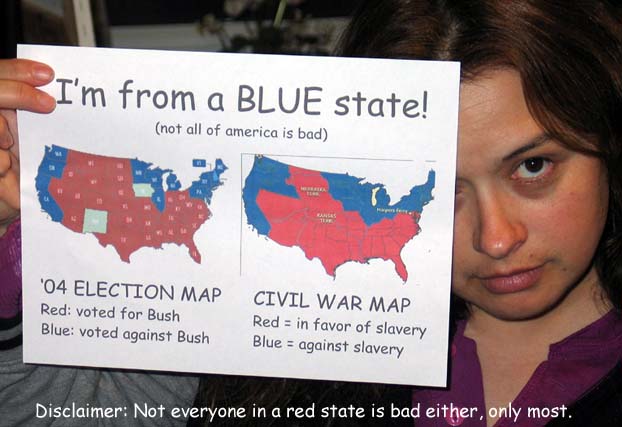
However, I don’t agree with the suggestion in the last line that the New Deal coalition is necessarily dead, though it is certainly on life support. Economic populism can and must be resuscitated, this time on a higher plane not encumbered by the ghostly albatrosses of Marxism. To state the obvious: just because Communism was a failure doesn't make capitalism perfect.
Thinking carefully about how FDR overcame the divisions of the Civil War would be a good start.
Values vs. self-interests
One of the more annoying things that we hear from liberals is whining about the GOP's ability to get the working class to vote "against its own economic interests."
It's annoying not so much because it smacks of a base-superstructure hangover, but because of the obvious lack of self-examination on the part of many of those who say this sort of nonsense. How many of the people who spout this claptrap are well-to-do lawyers, doctors, professors, or high tech executives? According to their own logic, shouldn't these people be voting for the candidate who's lining their pocket? Or do see themselves as suffering from "false consciousness" because they put aside their narrow economic interests and cast their ballots for the candidate that supports a woman's right to choose, tolerance for gays, and stem cell research?
Liberal doctors: heal thyselves!
The real point that liberals need to understand is that economic interest -- or, more pointedly, economic justice -- is itself a value that needs to be articulated and defended as a value.
It's annoying not so much because it smacks of a base-superstructure hangover, but because of the obvious lack of self-examination on the part of many of those who say this sort of nonsense. How many of the people who spout this claptrap are well-to-do lawyers, doctors, professors, or high tech executives? According to their own logic, shouldn't these people be voting for the candidate who's lining their pocket? Or do see themselves as suffering from "false consciousness" because they put aside their narrow economic interests and cast their ballots for the candidate that supports a woman's right to choose, tolerance for gays, and stem cell research?
Liberal doctors: heal thyselves!
The real point that liberals need to understand is that economic interest -- or, more pointedly, economic justice -- is itself a value that needs to be articulated and defended as a value.
Wednesday, November 10, 2004
An interesting comparison
Rejecting the idea of disinterested knowledge
I'm hardly the first to observe that one of the gravest problems with this Presidency is its default instinct to close communications channels, to release only "helpful" information.
Part of the instinct to close communications channels comes from the Bush regime's perception that the very notion of a free press is a farce. The media, as far as the Bush regime is concerned, are just another industry out to make money. Even leaving aside the alleged liberal bias of the press, the Bush regime basically looks at the press as being a corrupting social force that profits by promoting scandal and dissent. The notion that the press actually serves a useful communications purpose for the country -- the idea of "a fourth estate" -- is regarded as sentimental poppycock.
Don't most Americans think there ought to be some social instution charged with creating and distributing disinterested information, to keep the citizens informed on the critical matters of the day, without regard for political benefit?
Part of the instinct to close communications channels comes from the Bush regime's perception that the very notion of a free press is a farce. The media, as far as the Bush regime is concerned, are just another industry out to make money. Even leaving aside the alleged liberal bias of the press, the Bush regime basically looks at the press as being a corrupting social force that profits by promoting scandal and dissent. The notion that the press actually serves a useful communications purpose for the country -- the idea of "a fourth estate" -- is regarded as sentimental poppycock.
Don't most Americans think there ought to be some social instution charged with creating and distributing disinterested information, to keep the citizens informed on the critical matters of the day, without regard for political benefit?
Feeding the conspiracy theorists
One unfortunate side effect of the Bush regime’s "discipline" (the euphemism that some self-hating journalists adopt to refer to the White House's refusal to treat them as if they have a legitimate role in the democratic process) is that it stokes the fires of innuendo, rumor-mongering, and conspiracy theorizing which in any event tend to swirl around those who hold power. The lack of facts provides a swamp for conspiracy theories to breed in. For example, the White House's refusal to share information energizes those who suggest that Dick Cheney took dictation from energy company executives, as well as for those who question what took place at the Pentagon on the morning of September 11, 2001.
Let me be clear: I don’t buy the conspiracy theories. By definition, conspiracies theories only appear when there's just not enough evidence to make a definitive case, and I prefer definitive cases.
With that said, if the Bush regime were engaged in the skullduggery that the theorists insinuate, then its behavior -- the instinctive "no" regarding all requests for information -- would be indistinguishable from what we actually observe the White House doing.
Let me be clear: I don’t buy the conspiracy theories. By definition, conspiracies theories only appear when there's just not enough evidence to make a definitive case, and I prefer definitive cases.
With that said, if the Bush regime were engaged in the skullduggery that the theorists insinuate, then its behavior -- the instinctive "no" regarding all requests for information -- would be indistinguishable from what we actually observe the White House doing.
“The appearance” of disinformation
What all this adds up to is that the White House’s "communications" policy is corrupting the informational integrity of the country, with dire implications for the civic culture of the country.
The analogy to economic corruption is not just a metaphor. Over the years, Congress and the courts have banned various sorts of lobbying practices – for example, dinners, expensive gifts, honoraria, etc. for elected officials or judges – not because they are necessarily corrupt, but because they “give the appearance” of corruption. Put somewhat more pointedly, such acts are banned because if we didn’t ban them, then true corruption would always be able to claim that bribes were merely innocent gifts. Whenever courts and politicians render pronouncements on such laws, they inevitably include pious rhetoric about the need to avoid political cynicism.
The problem with the White House’s information policy is that it “gives the appearance” that something is being covered up and concealed. Even in the absence of a true cover-up, these appearances generate a similar cynicism about the political system that actual corruption does.
Informational corruption (or lack thereof) is more than just disturbing or annoying. It also undermines one of the bases of civic virtue: an informed and rational citizenry. If the people don’t have good information on which to reason through their decisions, then their decisions will necessarily be made on some basis other than reason.
Then again, maybe that’s precisely what this White House wants.
The analogy to economic corruption is not just a metaphor. Over the years, Congress and the courts have banned various sorts of lobbying practices – for example, dinners, expensive gifts, honoraria, etc. for elected officials or judges – not because they are necessarily corrupt, but because they “give the appearance” of corruption. Put somewhat more pointedly, such acts are banned because if we didn’t ban them, then true corruption would always be able to claim that bribes were merely innocent gifts. Whenever courts and politicians render pronouncements on such laws, they inevitably include pious rhetoric about the need to avoid political cynicism.
The problem with the White House’s information policy is that it “gives the appearance” that something is being covered up and concealed. Even in the absence of a true cover-up, these appearances generate a similar cynicism about the political system that actual corruption does.
Informational corruption (or lack thereof) is more than just disturbing or annoying. It also undermines one of the bases of civic virtue: an informed and rational citizenry. If the people don’t have good information on which to reason through their decisions, then their decisions will necessarily be made on some basis other than reason.
Then again, maybe that’s precisely what this White House wants.
Implications of electoral-vote splitting
One challenge that my proposed federal amendment would face is it would encourage the formation of third parties -- people with a large but still fractional agenda such as greens, white supremacists, socialists, or religious nutjobs of various stripes -- aiming to grab a few electoral votes. For example, in California this time around, even with the huge turnout, a mere 181,000 votes would have gotten you a seat at the Electoral College. In 2000, Ralph Nader would have picked up two electoral votes in California, and one each in a handful more states.
What's wrong with that, you ask? The problem is that a proliferation of third parties, while good for extending the scope of political debate in the country, would also greatly increase the likelihood that no candidate would end up with an EC majority. And that would mean that the election would be thrown to Congress, where the President would be chosen by the arcane (and even less regionally fair) mechanism of giving each state delegation one vote -- one each for Texas, New York, and California; and one each for Wyoming, Delaware, and Alaska. Over time, as third parties arose in large states to go after the fractional interest groups, having Presidential elections decided this way would likely become the norm rather than the exception. And although the small states might love that outcome, it would hardly be good for the republic.
A couple of additional provisions to the amendment could short-circuit this result. One option would be to have a run-off between the two leading EC vote getters. This solution has the disadvantage of stretching out the voting beyond a single day, with all sorts of unpleasant logistical and procedural implications. A better option would be to create a default provision in the amendment whereby, if no one were to achieve a majority in the EC, then whoever has a plurality of the popular vote nationally would be declared President.
From a policy perspective, this is in essence a compromise between Josh's proposal and my own. It has the advantage, however, of having a prayer of actually getting passed.
What's wrong with that, you ask? The problem is that a proliferation of third parties, while good for extending the scope of political debate in the country, would also greatly increase the likelihood that no candidate would end up with an EC majority. And that would mean that the election would be thrown to Congress, where the President would be chosen by the arcane (and even less regionally fair) mechanism of giving each state delegation one vote -- one each for Texas, New York, and California; and one each for Wyoming, Delaware, and Alaska. Over time, as third parties arose in large states to go after the fractional interest groups, having Presidential elections decided this way would likely become the norm rather than the exception. And although the small states might love that outcome, it would hardly be good for the republic.
A couple of additional provisions to the amendment could short-circuit this result. One option would be to have a run-off between the two leading EC vote getters. This solution has the disadvantage of stretching out the voting beyond a single day, with all sorts of unpleasant logistical and procedural implications. A better option would be to create a default provision in the amendment whereby, if no one were to achieve a majority in the EC, then whoever has a plurality of the popular vote nationally would be declared President.
From a policy perspective, this is in essence a compromise between Josh's proposal and my own. It has the advantage, however, of having a prayer of actually getting passed.
Tuesday, November 09, 2004
Amending the Electoral College
Josh Marshall argues in favor of abolishing the Electoral College, on the grounds that, by its nature, the EC effectively excludes from the political process anyone who lives in a non-swing state, since their votes are a foregone conclusion, and thus causes the political strategies of both parties to focus on liminal constituencies in a limited number of states.
He's absolutely right about the nature of the problem. As anyone who lives in Texas or California can attest, our views and issues have been systemically ignored by both political parties in each of the last election cycles. The campaigns have revolved entirely around the concerns of people in swing states, rather than around the issues that galvanize the American people as a whole.
With that said, I think Josh is being naive about the reality of ever amending the constitution to get rid of the EC. The small states simply have too much at stake in their overrepresentation in the EC. From there, it's a matter of arithmetic: since it takes only 13 states to block a constitutional amendment, why would the 13 smallest states (who only have 4% of the population) not block an amendment limiting their electoral clout?
However, there is a solution that largely solves the political problem Josh describes, but does so in a way that is less likely to raise the hackles of the small states.
The solution is to write a federal constitutional amendment modeled after the recently failed Colorado state amendment. Such an amendment would hold that state electoral votes be divvied up not on a winner-take-all basis, but proportionally, based on the number of direct votes a candidate received. Although it would not undo the unbalanced weight that small states have (and therefore would not be grounds for them to obstruct the amendment), it would mean that every state was "in play" -- getting an extra hundred thousand votes in California or Texas could swing an electoral vote.
The reason we need a federal amendment to do this follows from the reasons why the amendment in Colorado failed. Consider this: if you're Tom DeLay, running the Republican Party in Texas, why would you ever allow such an amendment to pass on a state level? It's effectively giving the Democrats ten extra electoral votes in a state that the Republicans otherwise have locked up. Likewise, if you're a Democrat in Massachusetts, why would you ever hand the Republicans four or five electoral votes?
In economics, this is known as a "first-mover problem" -- no one wants to make the first move, since the cost will fall on them, even though everyone will benefit if everyone makes the move. A federal constitutional amendment could breaking this national deadlock.
He's absolutely right about the nature of the problem. As anyone who lives in Texas or California can attest, our views and issues have been systemically ignored by both political parties in each of the last election cycles. The campaigns have revolved entirely around the concerns of people in swing states, rather than around the issues that galvanize the American people as a whole.
With that said, I think Josh is being naive about the reality of ever amending the constitution to get rid of the EC. The small states simply have too much at stake in their overrepresentation in the EC. From there, it's a matter of arithmetic: since it takes only 13 states to block a constitutional amendment, why would the 13 smallest states (who only have 4% of the population) not block an amendment limiting their electoral clout?
However, there is a solution that largely solves the political problem Josh describes, but does so in a way that is less likely to raise the hackles of the small states.
The solution is to write a federal constitutional amendment modeled after the recently failed Colorado state amendment. Such an amendment would hold that state electoral votes be divvied up not on a winner-take-all basis, but proportionally, based on the number of direct votes a candidate received. Although it would not undo the unbalanced weight that small states have (and therefore would not be grounds for them to obstruct the amendment), it would mean that every state was "in play" -- getting an extra hundred thousand votes in California or Texas could swing an electoral vote.
The reason we need a federal amendment to do this follows from the reasons why the amendment in Colorado failed. Consider this: if you're Tom DeLay, running the Republican Party in Texas, why would you ever allow such an amendment to pass on a state level? It's effectively giving the Democrats ten extra electoral votes in a state that the Republicans otherwise have locked up. Likewise, if you're a Democrat in Massachusetts, why would you ever hand the Republicans four or five electoral votes?
In economics, this is known as a "first-mover problem" -- no one wants to make the first move, since the cost will fall on them, even though everyone will benefit if everyone makes the move. A federal constitutional amendment could breaking this national deadlock.
Subscribe to:
Posts (Atom)